E-Rock. Creating Blend, Combining Styles, and
Composing Through Collaboration
Eliazer Kramer
| PDF | CITATION | AUTHOR |
Abstract
This article examines my participation in the ACTOR partnership’s 2019-2020 Composer-performer Orchestration Research Ensemble (CORE 1), and the methodology for achieving blend in my composition, E-Rock. The CORE 1 project was comprised of performance and composition students collaborating on new compositions for the heterogeneous ensemble of violin, bass clarinet, trombone, and vibraphone/small percussion. After initially struggling with timbre-base composition, I drew inspiration from klezmer music and jazz to bring cohesion to the ensemble and used compositional techniques inspired by timbre semantics and aural sonology to explore blend. Collaborating with the ensemble’s performers played an important role in shaping E-Rock: discussing how to translate different imagery into musical gestures offered ways to treat the ensemble as one instrument and allowed for a deeper exploration of blend. Ultimately, E-Rock demonstrates numerous approaches to blend, be it by a common style, imitation, or textures that make the ensemble more than the sum of its parts.
Keywords: ACTOR; blend; CORE; orchestration; timbre.
Résumé
Cet article examine ma participation à l’Ensemble de Recherche en Orchestration Contemporaine (EROC 1) du partenariat ACTOR en 2019-2020 et la méthodologie pour atteindre le fondu dans ma composition E-Rock. Le projet impliquait une collaboration entre étudiants en interprétation et composition pour créer des œuvres pour un ensemble hétérogène (violon, clarinette basse, trombone, vibraphone/petites percussions). Après des difficultés avec la composition timbrale, je me suis inspiré du klezmer et du jazz pour unifier les instruments et j’ai utilisé des techniques basées sur la sémantique du timbre et la sonologie auditive pour explorer le fondu. La collaboration avec les interprètes a été importante pour la création de E-Rock : discuter comment traduire des images en gestes musicaux a permis de traiter l’ensemble comme un seul instrument, approfondissant ainsi l’exploration du fondu. E-Rock montre diverses approches du fondu, que ce soit par un style commun, l’imitation, ou des textures qui unifient l’ensemble.
Mots clés : ACTOR ; EROC ; fondu ; orchestration ; timbre.
Introduction
I joined the Analysis, Creation, Teaching, and Research on Orchestration (ACTOR) partnership as a student member during the first year of my doctorate at the University of Montreal after being invited to participate in and compose a piece for the CORE 1 project.1Certain sections of this article derive from my thesis, From Live to Virtual: Developing an Idiomatic Style for the Virtual Orchestra (Kramer 2025). I was unfamiliar with ACTOR, but I welcomed the possibility for my music to be performed and the opportunity to collaborate with musicians. I learned that CORE is an ongoing research project in which composition and performance students collaborate each year to explore and solve orchestration-related problems by creating new compositions for a predetermined ensemble. This collaboration takes place over one year in the form of a seminar given at participating universities.
The 2019-2020 CORE project in Montreal consisted of four parts: the introduction phase, in which the students attended lectures on timbre and orchestration; the exploration and problem-solving phases, in which the composers workshopped different gestures, textures, sounds, and more fleshed-out passages with the performers;2E-Rock was workshopped and recorded by Mattia Berrini (violin), Alexandre Ducharme (percussion), Zacharie Fournier-Robert (trombone), Charlotte Layec (bass clarinet), and Jean-Michaël Lavoie (conductor). and the realization phase, in which the performers rehearsed the composers’ pieces.3The realization phase was supposed to culminate with a concert in April 2020. However, it was cancelled because of the COVID-19 pandemic. Instead, the University of Montreal CORE 1 project ended with a recording in October 2020. My participation in CORE 1 was unique because I attended the first two phases at both McGill University and the University of Montreal. This meant that I had more opportunities to experiment with the ensemble and that I could gain insight from the musicians from both schools.
Figure 1 illustrates this through a timeline dividing my participation at McGill (above) and the University of Montreal (below).
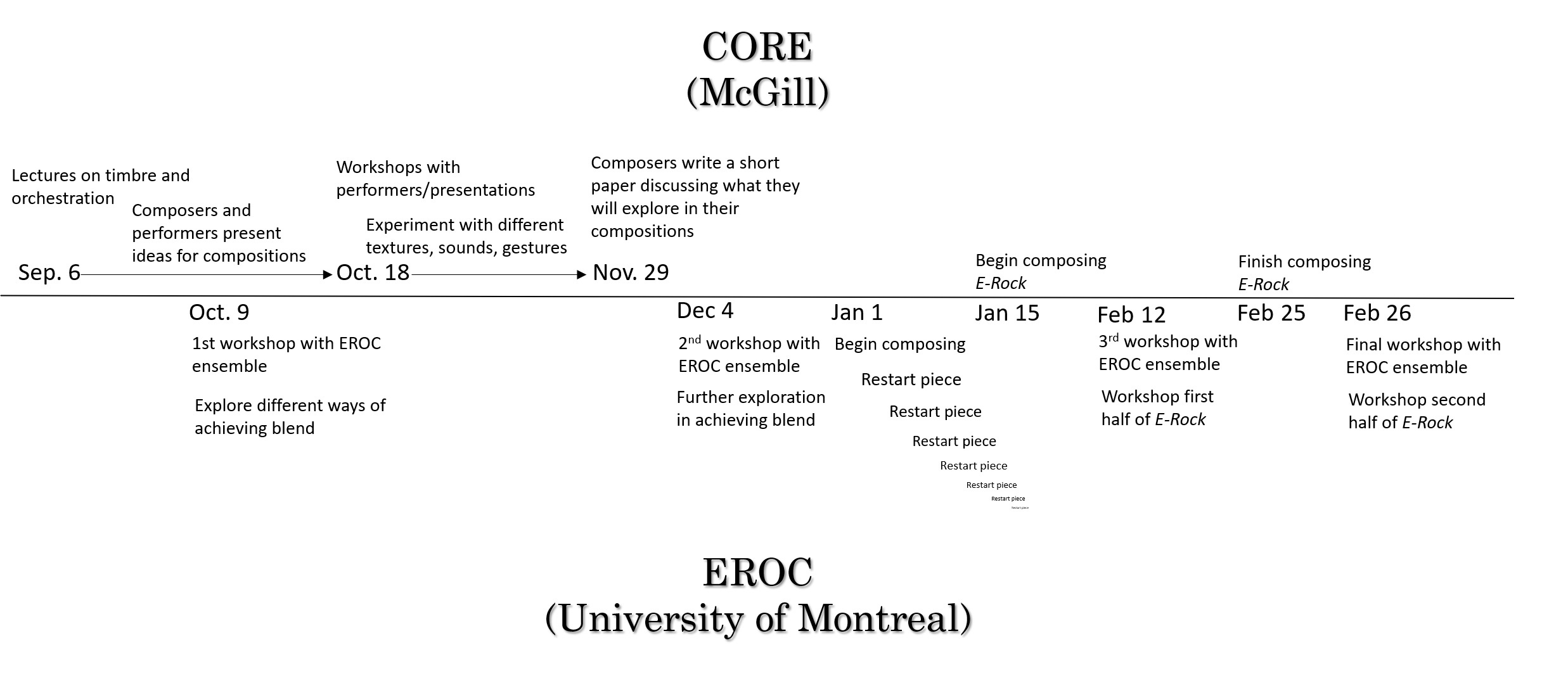 Figure 1: A timeline detailing my participation in the 2019-2020 CORE project with activities at McGill in the upper half and those at the University of Montreal in the lower half.
The introduction and exploration phases
The CORE 1 ensemble featured violin, bass clarinet, trombone, and vibraphone/small percussion. Its heterogeneous makeup led us to focus on how to achieve blend in our pieces and to explore how timbre could stimulate creativity or serve as a guiding force in composition. During the seminars, we discussed the orchestration challenges that could arise for the ensemble. For instance, the trombone could overpower the other instruments in forte passages, and fragile timbres, like violin harmonics, risked being masked within more active textures. The (implied) notion that the ensemble was inherently difficult to write for puzzled me. While I recognized that certain musical combinations may pose problems with balance and blend, there seemed to be a simple solution: to not write them.4Unless, of course, the composer’s intention was to create heterogeneous or unbalanced passage. Part of what inspired fear (and interest) about the ensemble was its rarity: it does not appear in the standard classical repertoire and thus offers limited musical points of reference. It was, by design, a completely wacky combination of instruments. Yet, from the beginning of the project, I remember thinking about how the violin, clarinet, trombone, and percussion often play together in klezmer ensembles. Why then should they be so difficult to unite?
Although there were no stylistic restraints for CORE 1, exploring and achieving blend seemed like it should be the goal of our compositions. This was never explicitly stated, and I have since been told that it was not the case, but the emphasis put on blend during the lectures and the fact that the CORE project examines how composers and performers solve orchestration problems related to a heterogeneous ensemble imprinted this notion within me.
This approach proved difficult for me because blend and timbre were never the guiding musical forces of my compositions. I was artistically driven by melody, rhythm, and harmony; the thought of writing a piece centred on sound for its own sake was so far removed from my artistic practice that it seemed an insurmountable task. Still, I was inspired by the research and techniques that I discovered during the introduction phase, and I sought ways to experiment with them in workshops with the ensembles.
One such approach is exemplified by Lasse Thoresen’s aural sonology, an analysis method that uses symbols instead of traditional notation to analyze music as it is heard (Thoresen and Hedman n.d.).5See: https://www.auralsonology.com/introduction. We were presented with this notation system as a tool to indicate the quality of sounds or textures we sought. For instance, represents a sustained pitched sound, while represents a short, dystonic sound or a sound “whose sound spectrum is formed by a mixture of pitched elements and clusters” (Thoresen and Hedman n.d., ch. 4).6See: https://www.auralsonology.com/the-signs/chapter-4-spectromorphology. Aural sonology’s notation also accounts for the timbral quality of sounds, with , for instance, indicating a “grainy” or coarse sound, and and indicating bright and dark sounds, respectively (Thoresen and Hedman n.d., ch. 4). Figure 2 shows a sketch that I wrote during the exploration phase which combines traditional notation in the bass clarinet with the graphic notation of aural sonology in the rest of the ensemble. While aural sonology proved a great tool to expand my conception of sound and discover ways to use the ensemble, I did not use its notation within E-Rock.
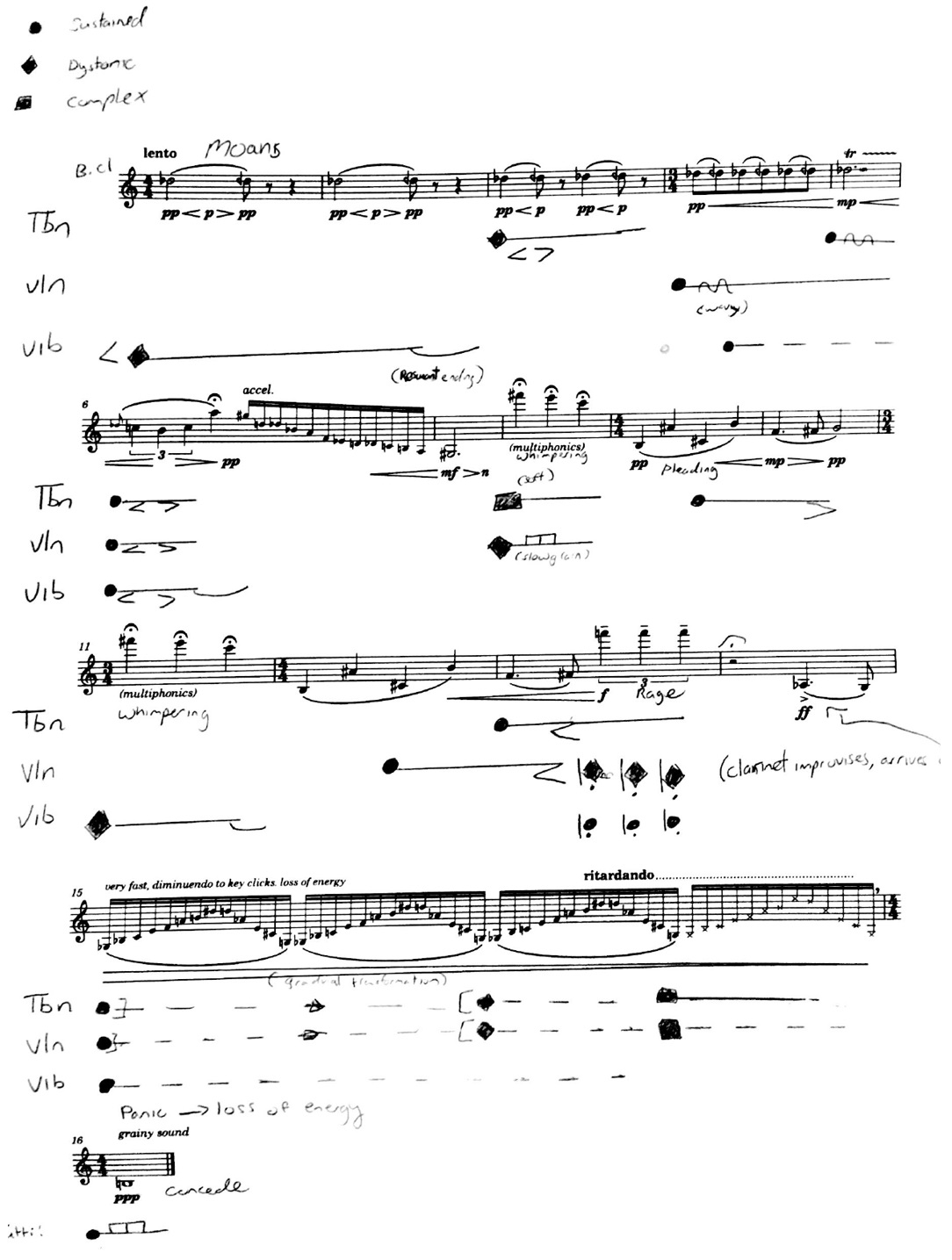
Figure 2: A sketch I wrote during the exploration phase of the CORE project that combines traditionally notated music and aural sonology’s graphic notation.
Another technique I discovered in the introduction phase was timbre semantics, or simply put, the description of timbre. Timbre semantics deals with the relation between human description and the conceptualization of sounds and their timbral qualities. In other words, how does describing a sound as, for instance, being “round” or “bright” relate to its timbral and physical properties (Saitis and Weinzierl 2019, p. 119-120). The strength of timbre semantics for composition lies in its capacity to springboard creativity. In a form of “reverse-engineering,” one could, for example, decide to write a passage that sounds “icy” and determine how each instrument could best be used to realize this description. This idea and compositional approach were inspiring to me and seemed to be another good way to deal with the heterogeneity of the CORE ensemble.
The most formative aspect of timbre semantics and aural sonology was that they caused me to continuously reflect on the timbral qualities of the different instruments and their playing techniques. When listening to the ensemble perform the composers’ sketches, I thought descriptively and categorized the different sounds I heard into groups like “airy,” “dystonic,” “warm,” or “grainy.” This newfound interest in sound quality represented a shift in how I thought about music as a composer.
The collaborative aspect
The CORE project was framed as a collaboration between performers and composers in the creation of new pieces. This was destabilizing. While the contemporary composer-performer relationship takes many forms, it is still often shaped by “the notion of the composer as the supreme controller of” the composition (Butt 2002, p. 97). This idea stems from the nineteenth-century view of the musical work as “a unique and autonomous” entity and helps explain the current tendency toward extensive notation of performance detail in the score (Butt 2002, p. 97). I highlight this practice and collaborative dynamic because they contextualize the composer-performer relationship in the CORE project and my desire to control the musical outcome through precise notation.
To move away from my impulse to control, I asked the performers to improvise on musical gestures that I described, but this proved less effective than working with a written score. Part of the challenge was that the ensemble was new to us, making it difficult for me to provide clear instructions and for the performers to offer spontaneous suggestions. Furthermore, some of the performers were not trained in improvisation. In my perception, these requests were often met with reticence or discomfort. At the same time, I felt that asking the performers to generate material in this way created an unbalanced dynamic: if the performers were expected to contribute to the creation of the pieces, why were the composers not expected to participate in their performance?
To facilitate experimentation, I composed short passages exploring blend during the workshops. However, this approach felt isolated and uninspiring, as though we were experimenting with blend in a vacuum. This prompted me to shift focus and compose E-Rock as quickly as possible. Ultimately, this meant we would workshop E-Rock, rather than co-create it. While this approach limited the scope of open-ended exploration, it still allowed me to incorporate passages and sounds inspired by the performers’ feedback.
In a collaborative project like CORE, in which composers and performers are expected to work together from a piece’s inception to its completion, the traditional hierarchical relationship between composer and performer presents challenges. Throughout the project, I struggled with what I call “composer’s guilt.” On the one hand, I felt that by asking the musicians to create without a detailed score, I was imposing my work on them. On the other hand, asking for feedback on a detailed score made me feel that everything revolved around me, as though the performers were only there for my benefit. I suspect the performers felt similarly conflicted because of their reluctance to offer suggestions.
E-Rock
I composed E-Rock with the intention of applying the concepts I learned in the CORE project in a musical language that resonated with me. Rather than write a piece defined by blend and timbral evolution, I used these as tools to spark creativity and to help inspire me to compose in ways that were new to me.
Figure 3: E-Rock’s full score. See the PDF version of the score.
Media 1: The recording of E-Rock performed by Mattia Berrini (violin), Alexandre Ducharme (percussion), Zacharie Fournier-Robert (trombone), Charlotte Layec (bass clarinet), Jean-Michaël Lavoie (conductor). Listen to Media 1.
Throughout the project, I continuously returned to the idea that the ensemble was well-suited to klezmer music. This association was a natural progression of my reflection on blend; because the ensemble does not exist in the classical repertoire, I thought of musical contexts it might inhabit. Thinking along these lines led me to realize that jazz is another style in which the ensemble’s instruments find their home. Writing in these styles seemed a good way to bring cohesion to the ensemble, and while doing so would not guarantee blend, I reasoned that it would unify the instruments by offering the listener a form of cultural blend or syncretism. The resulting form of E-Rock, outlined in Figure 4, reflects this idea by organizing the piece into sections that draw from klezmer, jazz, and a more personal, contemporary idiom.
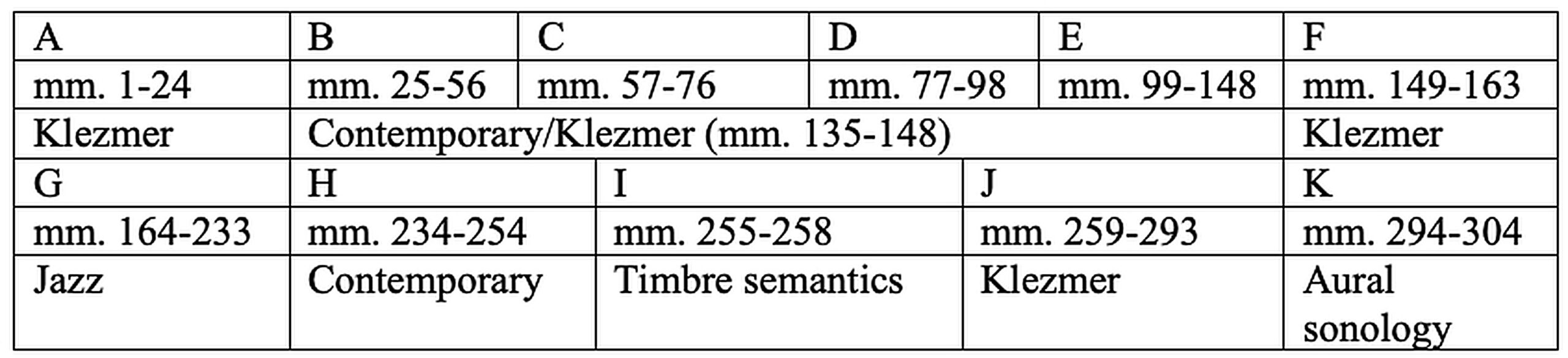
Figure 4: E-Rock’s form and select influences.
Throughout the compositional process, my continued reflection on blend in the ensemble led me to explore the following questions:7In the analysis of E-Rock, I reference passages related to these questions using the labels (a), (b), etc.
How do the violin, bass clarinet, and trombone blend while playing in three different octaves?
How can one imitate instruments within the ensemble?
Can analogous gestures render the ensemble more homogeneous?
Do the instruments blend while playing in the same absolute register?8By absolute register, I refer to the instruments playing the same notes. Playing around middle C, for example, may be in the lower register of the violin and the middle register of the trombone, however, both instruments would be playing the same absolute register.
How can one treat the ensemble as a single instrument?
While most of E-Rock’s material derives from its klezmer-inspired opening, it is continuously developed into a more personal/contemporary language, complexified, and presented through the lens of different influences. I did not research klezmer music for E-Rock; it is a style to which I have an affinity, with which I identify, and which I have used in other compositions. I structured the opening melody (see Figure 5) on the Phrygian-dominant scale,9The Phrygian-dominant scale is a harmonic minor scale starting on its 5th degree. which is one of klezmer music’s most identifiable characteristics, and composed music that awoke my dormant urge to dance (see Figure 6 for an example of this scale).
 Figure 5: The use of the Phrygian-dominant scale in E-Rock’s opening melody.
 Figure 6: The Phrygian-dominant scale starting on G.
The opening section ends with the violin, trombone, and bass clarinet playing in three different octaves (a) in mm. 23-24, as shown in Figure 7. The instruments, although discernible, blend particularly well when playing sustained octaves in this range. Their shared timbral warmth gives the ensemble a homogeneous quality, which is further enhanced by the richness of the low G’s in the violin’s double stops, which sound in unison with the bass clarinet. This passage is followed by a section that becomes increasingly chromatic and uses quartal harmony.
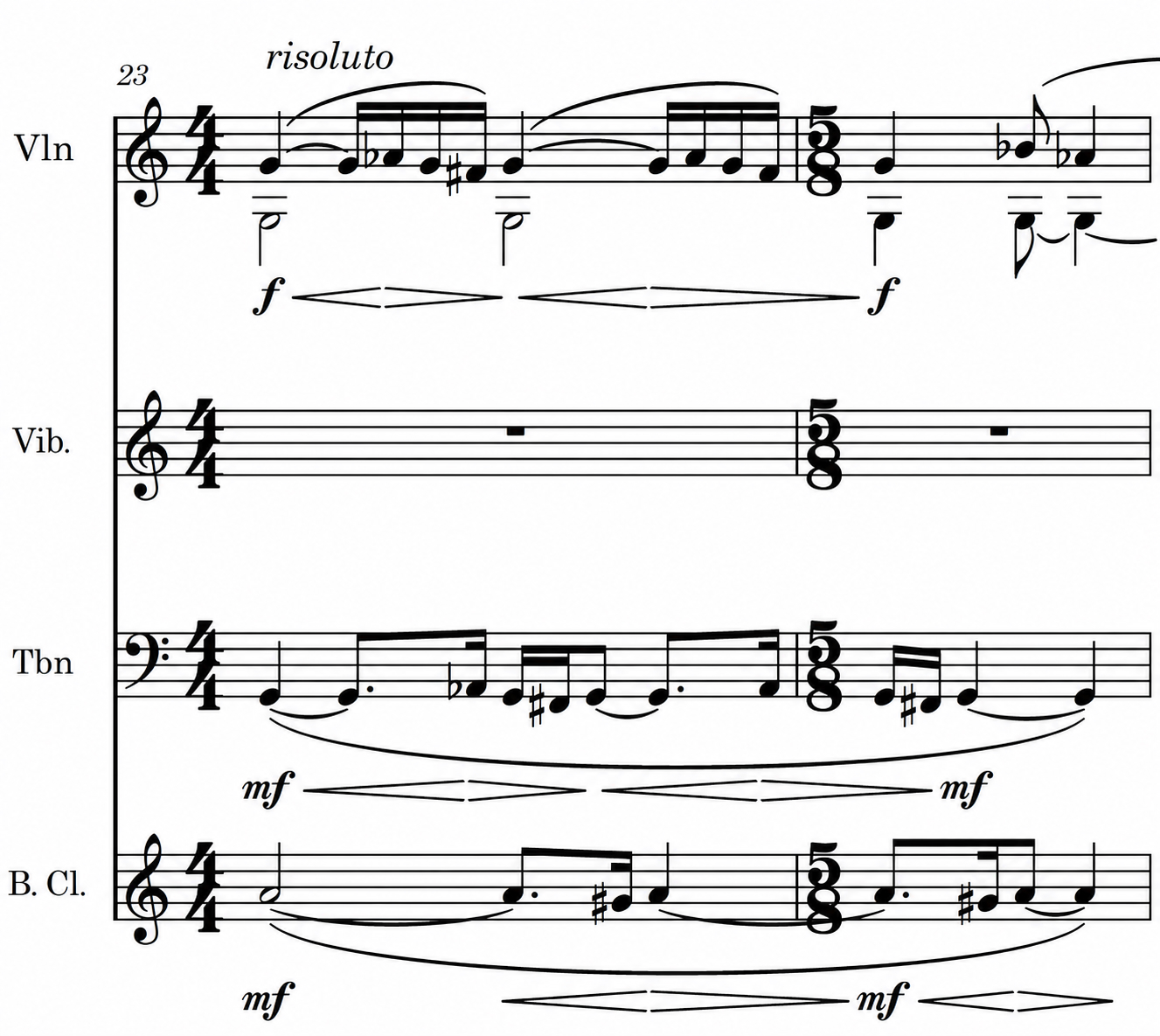
Figure 7: The three-octave blend in mm. 23-24 of E-Rock.
Media 2: The violin, bass clarinet, and trombone playing in octaves in mm. 23-24 of E-Rock. Listen to Media 2.
Measures 33-37 (Figure 8 and Media 3) show a simple attempt at homogeneity through the bass clarinet’s use of poco slap to imitate the timbre of the violin’s pizzicato (b), while reducing the perceived breadth of its sonority. When writing this passage, I imagined the bass clarinet sharing the percussive, “wood-like” timbral qualities of the violin’s pizzicato, so that alternation between the two instruments would create a perceptual link between their motifs. This kind of continuous timbral connection corresponds to what McAdams et al. describe as “stream integration” in their taxonomy of orchestral grouping effects (McAdams et al. 2022, p. 11). Although the resulting timbres share certain perceptual qualities, such as a rich, round tone, they yield a less seamless imitation than I had envisioned. The main culprit here is the difference in size between the two instruments’ sonorities, or what Koechlin describes as their équilibre successif (Koechlin 1954-1959, p. 262). The bass clarinet sounds much larger, or “fatter,” than the violin’s pizzicato and this, more than any timbral differences between the two, disrupts their imitative stream.
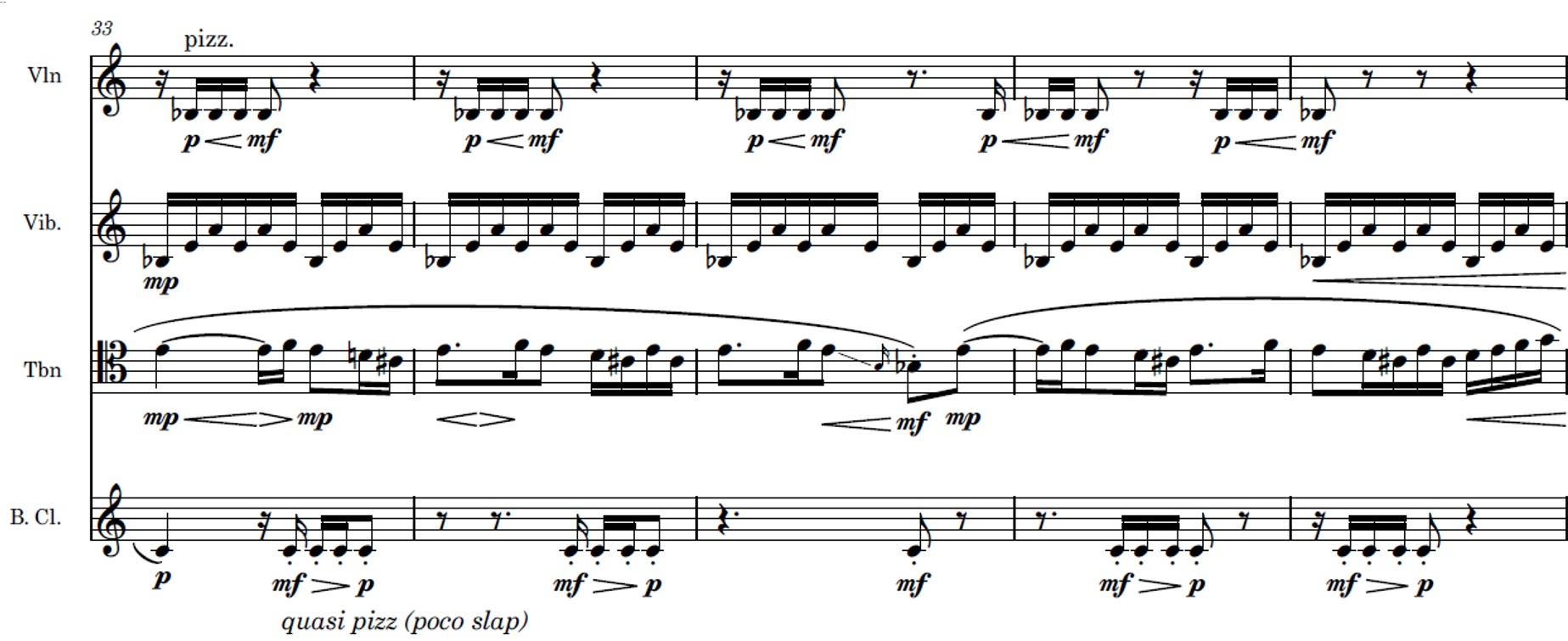 Figure 8: Timbral imitation between the violin and bass clarinet in mm. 33-37 of E-Rock.
Media 3: Imitation between the violin and the bass clarinet in mm. 33-37. Listen to Media 3.
Imitation, whether timbral, motivic, or even stylistic, characterizes much of E-Rock. Section D (mm. 77-98) begins with analogous gestures (c) between the bends in the violin and the vibraphone, an idea that is reprised between the violin and trombone in mm. 151-152 and continues with motivic imitation of repeated notes and short trills in various instruments. Neither of these sets of analogous gestures produces a sense of homogeneity between the instruments. If anything, they highlight the instruments’ timbral differences: the metallic quality of the vibraphone shines through in section D, and in both examples, the violin’s pizzicato sound (unsurprisingly) like pizzicato. The resulting perceptual effect is one of contrast, with each iteration recasting the musical idea through timbral shifts.
At the beginning of section E, in m. 99, the violin, trombone, and bass clarinet begin playing a descending and rising motif in the same absolute register (d) before expanding and arriving at a klezmer outburst in m. 135. Similar to mm. 23-24, the warmth of the instruments’ register at the beginning of section E promotes blend, particularly at softer dynamics. In fact, the hairpins throughout this passage result in the instruments weaving continuously in and out of blend. For instance, the trombone’s crescendo in m. 100 makes it sound increasingly brassy, causing it to stand out more prominently in the texture (see the second measure of Figure 9).
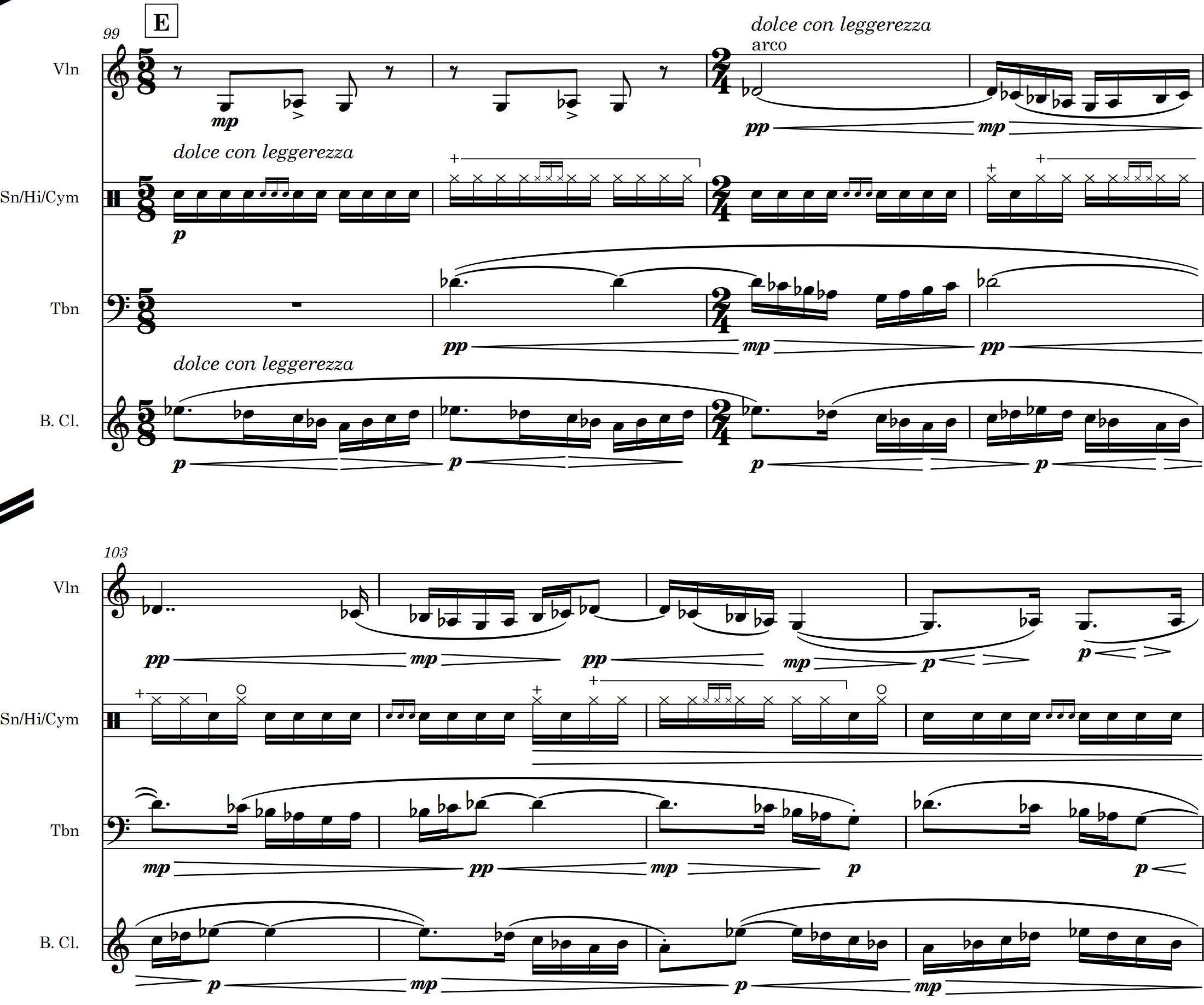
Figure 9: The violin, trombone, and bass clarinet weaving in and out of blend in mm. 99-106 of section E.
Media 4: The violin, trombone, and bass clarinet weaving in and out of blend in the beginning of section E. Listen to Media 4.
A noteworthy aspect of section E (and, in fact, all the examples thus far) is that I only conceived of it because of my newfound interest in blend and timbre. I wanted to see how these instruments would sound while playing within the same range, and this gave rise to an entire section of the piece. Indeed, E-Rock is defined less by how successfully it achieves blend and imitation than by how the pursuit of these became compositional tools that shaped its language.
Measures 149-163 see a partial return of the opening melody presented in 7/8 and transition to E-Rock’s jazz section, which begins with a duo between the snare drum and the bass clarinet. A more elaborate example of instrumental imitation (b) occurs after the duo in the bass clarinet, in m. 179. In this passage, the bass clarinet imitates the sound of the hi-hat and the snare drum by beatboxing ts and k consonants and by playing sustained notes with a loose embouchure. The violin enters at m. 204, mimicking the double bass by playing a bass line in pizzicato, and then acts as the percussion in mm. 209-217 through taps to its body.
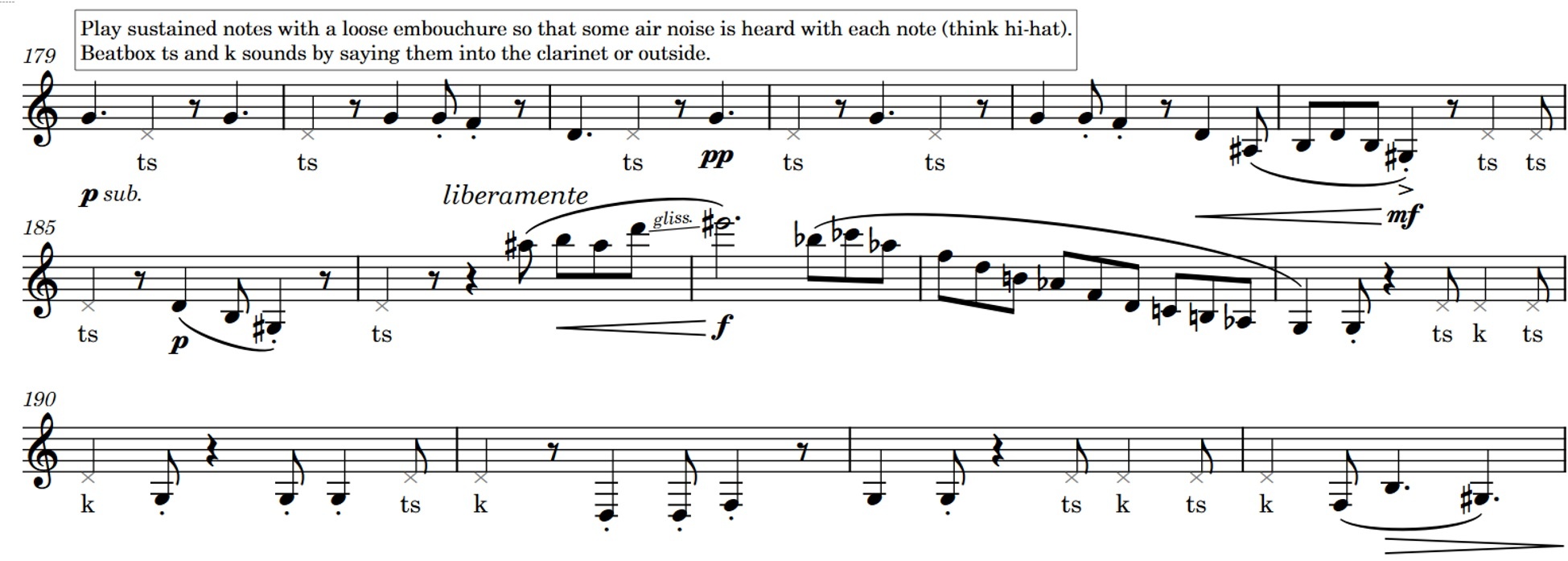 Figure 10: The bass clarinet’s beatboxing solo in mm. 179-198 of E-Rock.
Media 5: The bass clarinet’s beatboxing solo in mm. 179-198 of E-Rock. Listen to Media 5.
Media 6: Workshopping the bass clarinet’s beatboxing solo during the problem-solving phase of CORE 1. Watch Media 6.
The jazz section fades out as the trombone plays a solo. This leads to a passage (m. 249) in which I try to achieve blend by using the ensemble as a single instrument (e). This was inspired by the concept of timbral emergence, in which different timbres merge to form a unified timbre that is distinct from those of the contributing instruments (McAdams et al. 2022, p. 8). Typically, this occurs when instruments play sustained notes (often in homorhythm), but even fast articulated notes can produce this type of timbral fusion (McAdams and Touizrar 2016, p. 11).
To arrive at this, I workshopped analogous gestures (c) with the ensemble to find a combination of complementary timbres. Ultimately, I did not succeed in producing timbral emergence; although the similar musical gestures between the instruments attempt to treat the ensemble as one instrument (see Figure 11), the resulting sound remains heterogeneous. In my perception, the shortcomings of this passage can be attributed to three main factors: a focus on gesture over sonic outcome, a lack of timbral alignment, and the limitations of the notation.
While using glissandi amongst the instruments to create a unified gesture seemed coherent, the resulting sonorities diverge significantly. The vibraphone becomes increasingly discernible as it plays higher and its dynamics increase, and the bass clarinet’s harmonic glissando produces a unique timbre that stands out from the rest. The graininess of the violin double stops sometimes blends with the trombone; however, the latter dominates, so at best this can be considered a form of timbral augmentation (McAdams et al. 2022, p. 7). Furthermore, the segregation of the violin–trombone and vibraphone–bass clarinet pairings creates a structural rupture in the ensemble texture; the violin and bass clarinet articulate their glissandi with short pauses between events, whereas the vibraphone and trombone produce more continuous gestures.
The approximate notation I used is detrimental to the goals of the passage. A more effective approach would have been either to adopt hyper-detailed, highly prescriptive notation to tightly control the sonic outcome, or, more daringly, to use aural sonology’s proposed notation as a roadmap for performers to pursue a specific gesture while enabling them to adapt in real time to the emerging timbre.
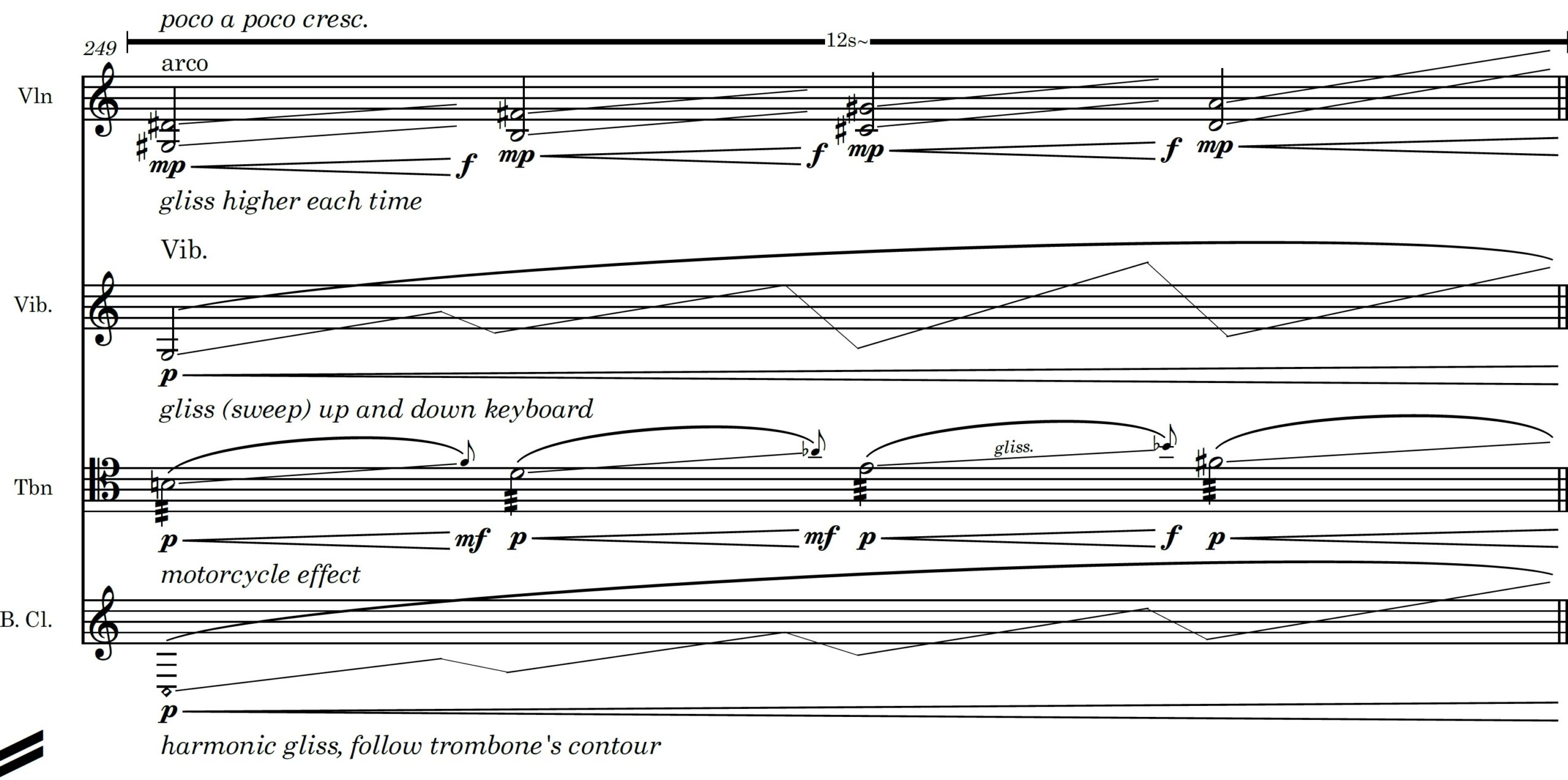 Figure 11: Using the CORE ensemble as one instrument in m. 249 of E-Rock.
Media 7: Measure 249 of E-Rock. Listen to Media 7.
I sought to contrast the dynamism and climactic ending of the previous section with a much thinner texture in a passage inspired by timbre semantics (see mm. 254-258 in Figure 12). To do this, I associated playing techniques with the words “airy” and “icy”: the whispering quality of harmonics in the violin made me think of a cold wind; playing the cymbal and vibraphone with the bow gave rise to a similar image, albeit an even more chilling one; air noises in the trombone need no clarification; and the multiphonics in the bass clarinet have a thin and wind-like quality. Perhaps unsurprisingly, this passage is more successful in producing homogeneous textures or “pockets of homogeneity,” than those based on analogous gestures. Whereas the latter was essentially a “let’s see what happens” approach, using timbre semantics as a compositional technique forced me to reflect on how the instruments could converge toward sounds with similar attributes. Media 8 demonstrates this through the unified texture arising from the shared ethereal and delicate qualities of the instruments.
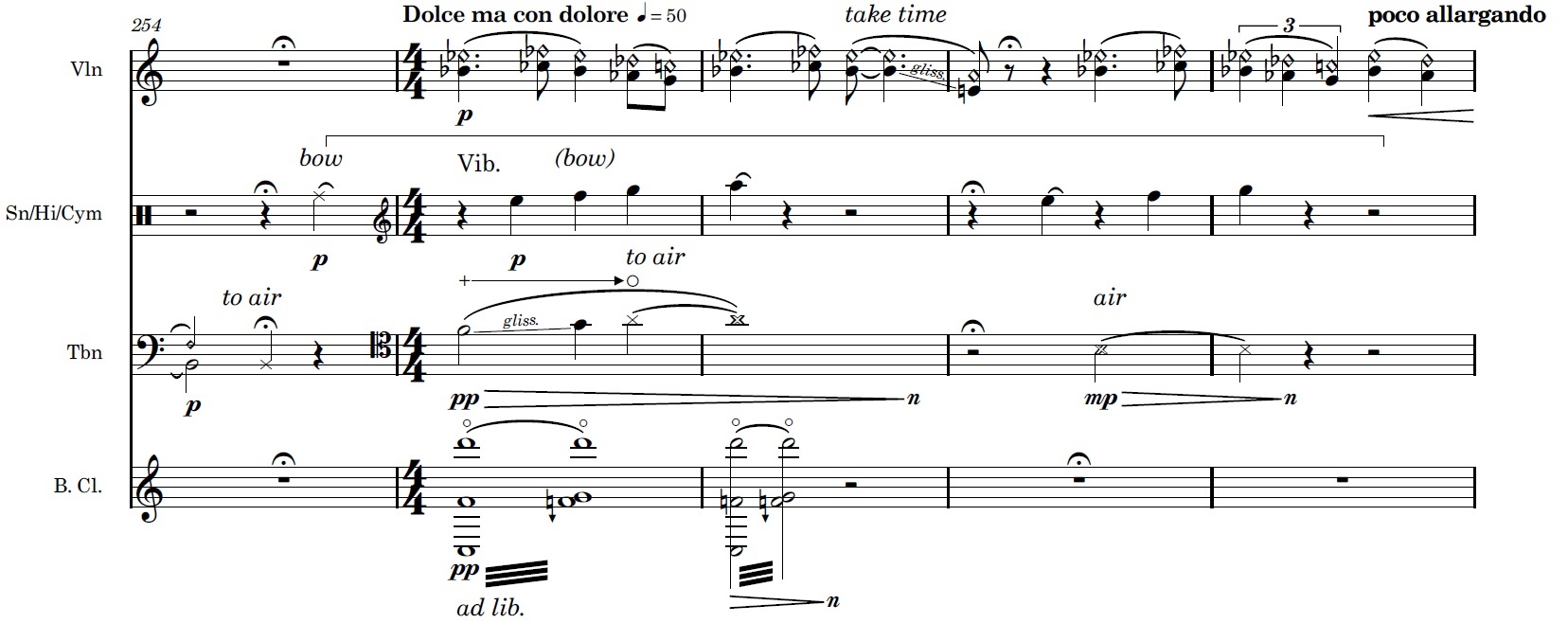 Figure 12: The “airy” and “icy” texture in mm. 254-258 of E-Rock.
Media 8: The “airy” and “icy” texture in mm. 254-258 of E-Rock. Listen to Media 8.
The penultimate section of the piece recapitulates earlier melodies and motifs in a long accelerando meant to evoke an increasingly energetic klezmer band. The accelerando is interrupted in mm. 276-277 by a sudden halt in tempo and humorous interjection, in which the violin plays part of Israel’s national anthem “Hatikva,”10“Hatikva” is an example of Jewish music that uses the Phrygian-dominant scale. while the trombone and vibraphone accompany it in the “wrong key” and the bass clarinet plays multiphonics (with the affectionate playing indication of “like bad plumbing”). The accelerando continues, and in mm. 282-285, the violin and bass clarinet play analogous glissando gestures in dialogue (c), which, once again, does not result in greater homogeneity (Figure 13).
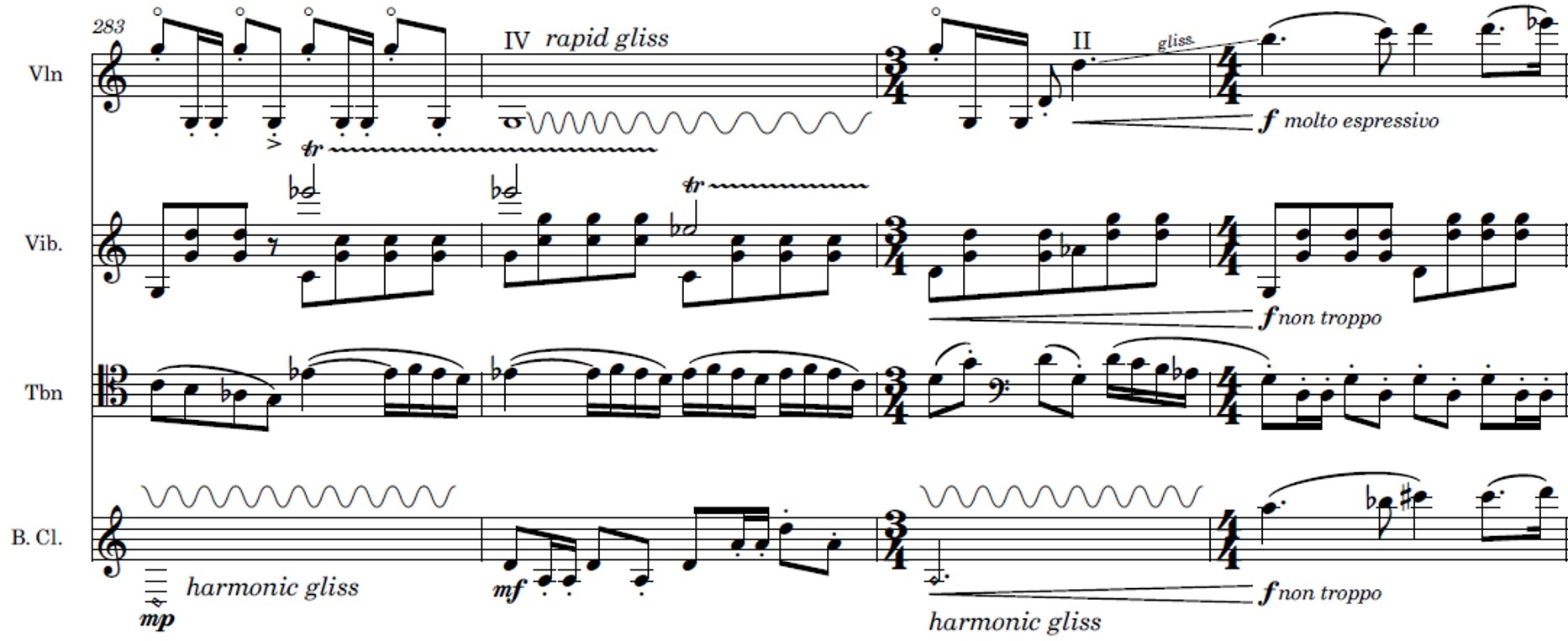 Figure 13: Analogous gestures in the bass clarinet and violin in mm. 283-286 of E-Rock.
E-Rock concludes with a coda (mm. 294-304), in which the performers are meant to play so rapidly that they begin to lose control. Measures 299-303 are inspired by the image of a speaker bursting and the evolution of sound from pitched (m. 299), to dystonic (mm. 301-302), to complex11Sounds that do not have a perceived fundamental. (m. 303). This is an illustration of how aural sonology influenced and led me to compose by thinking of broader gestures based on the qualities of sounds (see Figure 14 and Media 9).To simulate distortion, the instruments play a crescendo in an increasing dystonic gesture: the violin increases in bow pressure, as it plays sextuplets that ascend its upper three strings, the percussion plays a tremolo on the rim, the trombone plays a glissando in flutter tongue, and the bass clarinet plays a harmonic glissando. This is followed by a sudden change in dynamics, in which the instruments play finger noise or key clicks, implying that they can no longer produce sound. E-Rock ends with the entire ensemble playing the same note, as if to suggest it has finally achieved blend.
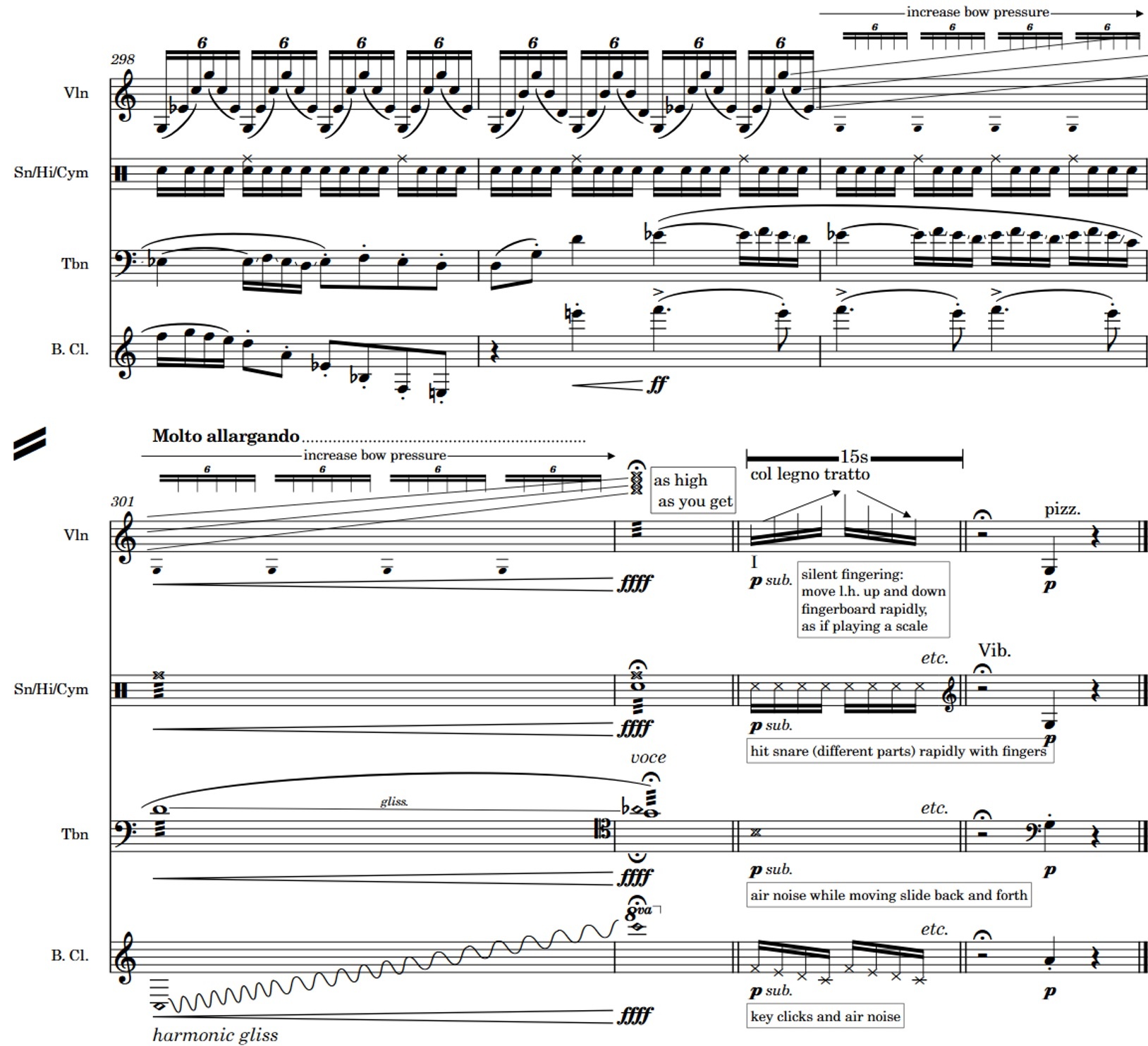 Figure 14: The influence of aural sonology in E-Rock.
Media 9: Measures 298-304 of E-Rock. Listen to Media 9.
Conclusion
CORE was one of the most formative projects I have participated in as a composer. Initially, I felt ill at ease with many of the new concepts related to timbre and blend that I discovered. Throughout much of the project, I worried that I would be unable to produce a composition. I struggled because, instead of finding ways to integrate these new concepts into my compositional voice, I attempted to compose in ways that did not resonate with me.
Despite this initial discomfort, the experience was a crucial step in my artistic development; composers need to challenge themselves to expand their horizons. Had I started composing in a way that felt comfortable, I likely would not have developed as much. At the same time, it is important to compose in a way that feels meaningful and true to oneself. One should not feel discouraged if one is willing to grow and seek new forms of expression.
Although the composer-performer dynamic within CORE was not always clear, the project’s collaborative aspect helped shape E-Rock. Group and individual meetings provided solutions to technical, musical, and blend-related problems, while structured and free improvisation sessions yielded spontaneous results that I either directly implemented into the piece or further developed.
Almost every passage I wrote in E-Rock reflects a deeper awareness of timbre and its relationship to orchestration. This awareness, rather than any specific concepts I learned, is my most valuable takeaway from CORE. Its influence has rippled through my doctorate and into my current work by providing me with new tools to write with and new musical interests to explore. The experience has transformed my approach to composition and enriched my music without abandoning my artistic identity.
Bibliography
Butt, John (2022), Playing with History. The Historical Approach to Musical Performance, Cambridge University Press.
Koechlin, Charles (1954–1959), Traité de l’orchestration, en quatres volumes. Volume 1, Paris, Max Eschig.
Kramer, Eliazer (2025), From Live to Virtual. Developing an Idiomatic Composition Practice for the Virtual Orchestra, D. Mus diss., Université de Montréal.
Kramer, Eliazer (2020), E-Rock, Mattia Berrini (violin), Alexandre Ducharme (percussion), Zacharie Fournier-Robert (trombone), Charlotte Layec (bass clarinet), Jean-Michaël Lavoie (conductor), unpublished audio recording.
McAdams, Stephen., Meghan Goodchild, and Kit Soden (2022), “A taxonomy of Orchestral Grouping Effects Derived from Principles of Auditory Perception,” Music Theory Online, vol. 28, nº 3, https://doi.org/10.30535/mto.28.3.6, accessed April 21, 2026.
Saitis, Charalampos, and Stefan Weinzierl (2019), “The Semantics of Timbre,” in Kai Siedenburg, Charalampos Saitis, Stephen McAdams, Arthur N. Popper, and Richard R. Fay (eds), Timbre. Acoustics, Perception, and Cognition, Cham, Springer Handbook of Auditory Research, pp. 119–149, https://doi.org/10.1007/978-3-030-14832-4_5.
Touizrar, Moe, and Stephen McAdams (2019), “Perceptual Facets of Orchestration in The Angel of Death by Roger Reynolds. Timbre and Auditory Grouping,” Analyse musicale et perception. Actes des Journées d’Analyse Musicale 2016, Éditions universitaires de Dijon.
Thoresen, Lasse, and Andreas Hedman (n.d.), Aural Sonology. Emergent Musical Forms, https://www.auralsonology.com/introduction/, accessed 23 February 2025.
 |
RMO_vol.13.1_Kramer |
Attention : le logiciel Aperçu (preview) ne permet pas la lecture des fichiers sonores intégrés dans les fichiers pdf.
Citation
- Référence papier (pdf)
Eliazer Kramer, « E-Rock. Creating Blend, Combining Styles, and Composing Through Collaboration », Revue musicale OICRM, vol. 13, no 1, 2026, p. 224-239.
- Référence électronique
Eliazer Kramer, « E-Rock. Creating Blend, Combining Styles, and Composing Through Collaboration », Revue musicale OICRM, vol. 13, no 1, 2026, mis en ligne le 2 juin 2026, https://revuemusicaleoicrm.org/rmo-vol13-n1/e-rock-blend-combining-styles-composing-through-collaboration/, consulté le…
Author
Eliazer Kramer, Université de Montréal
Eliazer Kramer is a pianist and composer from Montreal. He completed his master’s in piano performance at the University of Gothenburg in Sweden and at the Sibelius Academy in Finland. In 2015, he completed his D.E.P.A. in piano performance at the University of Montreal under the guidance of Paul Stewart. Eliazer completed a master’s in composition with François-Hugues Leclair and Denis Gougeon. In 2025, he completed his doctorate in composition with François-Xavier Dupas and Caroline Traube. Eliazer works as a composer for screen media at SIDE Montreal and teaches audio and music for video games at Université de Montréal.
Notes
| ↵1 | Certain sections of this article derive from my thesis, From Live to Virtual: Developing an Idiomatic Style for the Virtual Orchestra (Kramer 2025). |
|---|---|
| ↵2 | E-Rock was workshopped and recorded by Mattia Berrini (violin), Alexandre Ducharme (percussion), Zacharie Fournier-Robert (trombone), Charlotte Layec (bass clarinet), and Jean-Michaël Lavoie (conductor). |
| ↵3 | The realization phase was supposed to culminate with a concert in April 2020. However, it was cancelled because of the COVID-19 pandemic. Instead, the University of Montreal CORE 1 project ended with a recording in October 2020. |
| ↵4 | Unless, of course, the composer’s intention was to create heterogeneous or unbalanced passage. |
| ↵5 | See: https://www.auralsonology.com/introduction. |
| ↵6 | See: https://www.auralsonology.com/the-signs/chapter-4-spectromorphology. |
| ↵7 | In the analysis of E-Rock, I reference passages related to these questions using the labels (a), (b), etc. |
| ↵8 | By absolute register, I refer to the instruments playing the same notes. Playing around middle C, for example, may be in the lower register of the violin and the middle register of the trombone, however, both instruments would be playing the same absolute register. |
| ↵9 | The Phrygian-dominant scale is a harmonic minor scale starting on its 5th degree. |
| ↵10 | “Hatikva” is an example of Jewish music that uses the Phrygian-dominant scale. |
| ↵11 | Sounds that do not have a perceived fundamental. |