Analyzing Approaches to Orchestral Grouping and Integration
in the Composer-performer Orchestration
Research Ensemble (CORE)
Yuval Adler, Robert Hasegawa and Joshua Rosner
| PDF | CITATION | AUTHORS |
Abstract
The 2019–2020 Composer-performer Orchestration Research Ensemble (CORE) at McGill University challenged three composers (Quentin Lauvray, Pedram Diba, and Alexander Blank) and four performers (Elia Foster, Ryan Cass, Martin Daigle, and Jeanne Côté) to create new works for a heterogeneous quartet of bass clarinet, trombone, vibraphone (with optional handheld auxiliary percussion), and violin. This article discusses how the composers and performers solved particular orchestrational problems, with specific attention to issues of balance, blend, textural integration, and “gestural integration” (a new term we propose to add to existing classifications). We conclude by exploring communication, with a focus on how sonic goals were expressed through musical notation (marked by a dialectic of notational specificity and freedom) as well as through shared vocabulary introduced and developed in the CORE seminar.
Keywords: gestural integration; grouping effects; musical communication; orchestration, timbre.
Résumé
L’Ensemble de recherche sur l’orchestration contemporaine (EROC) 2019-2020 de l’Université McGill a mis au défi trois compositeurs (Quentin Lauvray, Pedram Diba et Alexander Blank) et quatre interprètes (Elia Foster, Ryan Cass, Martin Daigle et Jeanne Côté) de créer de nouvelles œuvres pour un quatuor hétérogène unique composé d’une clarinette basse, d’un trombone, d’un vibraphone (avec percussion auxiliaire à main en option) et d’un violon. Cet article examine comment les compositeurs et interprètes ont résolu des problèmes d’orchestration particuliers, en accordant une attention spécifique aux questions d’équilibre, d’harmonie, d’« intégration gestuelle » (un nouveau terme que nous proposons d’ajouter aux classifications existantes) et d’intégration texturale. Nous concluons en explorant la communication, en nous concentrant sur la manière dont les objectifs sonores ont été exprimés à travers la notation musicale (marquée par une dialectique entre spécificité et liberté notationnelles) ainsi qu’un vocabulaire commun introduit et développé lors du séminaire EROC.
Mots clés : communication musicale ; effets de regroupement ; orchestration ; intégration gestuelle ; timbre.
Introduction
This article focuses on the edition of the CORE (Composer-performer Orchestration Research Ensemble) seminar which took place at McGill in 2019 and 2020, led by faculty members Stephen McAdams, a music psychologist specializing in the perception of timbre and orchestration, and Guillaume Bourgogne, a conductor specializing in contemporary music. At McGill, as at the other participating universities, student composers wrote for a quartet with a diverse instrumentation designed (at least in part) to create orchestrational challenges. The four McGill performers were Jeanne Côté (violin), Ryan Cass (trombone), Elia Foster (bass clarinet), and Martin Daigle (percussion), and the three student composers were Quentin Lauvray, Pedram Diba, and Alexander Blank. Both during and after the CORE seminar, materials including video recordings, archived sketch materials, questionnaires, and interviews were collected to document the creative process.1Materials from the CORE project from all participating institutions are available online here: https://timbreandorchestration.org/research-ensembles. In this article, we will discuss how these composers and performers solved particular orchestrational problems, with particular attention to issues of balance, blend, textural integration, and “gestural integration” (a new term we propose to add to existing classifications). In the final section of the article, we explore how these compositional solutions were communicated to performers, with particular attention to how sonic goals were expressed through musical notation (marked by a dialectic of notational specificity and freedom) as well as shared vocabulary developed through the CORE seminar.
McGill’s CORE seminar curriculum included study of the Taxonomy of Orchestral Grouping Effects (TOGE) which would be published a few years later by Stephen McAdams, Meghan Goodchild, and Kit Soden (McAdams et al. 2022). The TOGE, drawing inspiration from Albert Bregman’s research on auditory scene analysis (1990) as well as newer findings from the ACTOR (Analysis, Creation, and Teaching of Orchestration) research partnership, categorizes the various ways that sound sources (such as instruments in an ensemble) are perceptually grouped together—or in some cases kept distinct—resulting in various kinds of blend, layering, integration, and segregation.
Integration was one of the most fascinating concepts to composers in the McGill seminar, due in no small part to the inherent challenge of making this particular ensemble’s instruments fit together into a cohesive whole. Broadly speaking (and before the articulation of any particular compositional goals), the timbral heterogeneity of the ensemble provides an orchestrational challenge to composers: how can the instruments be combined into a unified auditory percept? The instruments are drawn from four different instrumental families and represent different modes of sound production (blowing into a reed, buzzing into a mouthpiece, bowing or plucking, and striking) and also have quite distinct ranges with limited registral overlap. The high degree of contrast between the ensemble’s instruments was a conscious choice on the part of the CORE project creators, Stephen McAdams and composer Roger Reynolds (see their article in this volume). While cohesion is by no means the only desideratum in ensemble writing (and is perhaps less sought after in contemporary idioms than in the eighteenth- and nineteenth-century orchestral repertoire), establishing some degree of coordination and combination of the instruments is an important concern for any composer approaching this instrumentation.
While arguably “integration” could be said to occur whenever multiple sound sources are perceptually combined (integrated) into a single percept, in the TOGE the term is reserved primarily for sequential phenomena (i.e., phenomena unfolding over time). McAdams et al. (2022) describe the perceptual grouping of simultaneous phenomena as “blend” (a term that itself comprises several different varieties). “Integration,” then, is a phenomenon that happens over time. “We distinguish,” McAdams et al. write, “two types of sequential grouping integration: stream integration and integration of a surface texture” (2022, 5.6; see Figure 1).
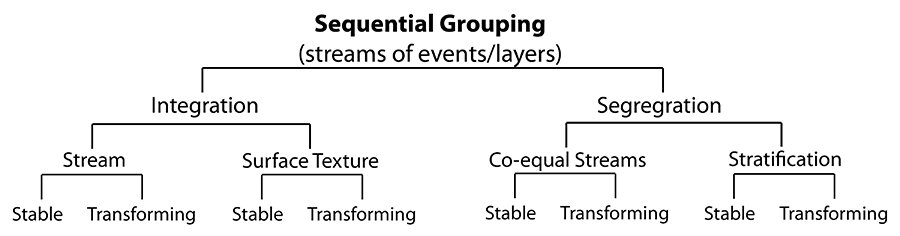 Figure 1: McAdams et al.’s “taxonomy of sequential auditory grouping phenomena” (2022, Example 12).
“Stream integration” refers to the experience of a sequence of notes (broadly speaking, a melody or line) cohering together into a unified, integrated percept: “consistent timbre, register, and dynamics across a sequence of notes helps them to be connected perceptually into an auditory stream” (McAdams et al. 2022, 5.6). An integrated stream can also be heard when a sequence of blended instruments proceeds in parallel (for example multiple orchestral instruments playing a melody in unison). If the instrument (or group of instruments playing together) changes over time (but not enough to break the sense of a temporally integrated percept), the stream integration will be “transforming” instead of “stable.”
“Integration of a surface texture” is a “looser perceptual grouping than stream integration.” It occurs “when two or more instruments have different material—contrasting rhythmic figures and/or pitch material—but are integrated perceptually into a single surface texture; the term ‘texture’ is used here more in its meaning of the consistency of a surface than an aggregation of layers” (McAdams et al. 2022, 5.6). “Texture” is a famously elusive word in music scholarship: some sources use the familiar classifications of monophony, homophony, polyphony, etc. to describe the number and interrelationship of musical layers, but composers, performers, and scholars also use “texture” in a number of complex and metaphorical ways (Frymoyer 2012). Perhaps most relevant to the idea of “surface texture integration” is the metaphor of a woven cloth—like the cloth, textures feature a complex “weave” of components that yield an emergent sensual quality or feeling. This haptic aspect of texture is important in many composers’ use of the term. And just as a cloth or fabric has extension in space, a texture can be extended in musical time. Composer Fabien Lévy offers a compatible definition of the term from the context of “functional orchestration” in his contribution to The Oxford Handbook of Orchestration Studies:
I define a texture as a particular coupling, where a combination of two or more moving elements is perceived as one merging element, for a sustained time, either static or in a continuous transition. There is neither perception of concurrent segregation between simultaneous elements, nor sequential contrasts or temporal rapid changes in the object’s perception, but a perception of one unity between the expressible and the inexpressible, both in the moment and over time, concomitant with a perception of either stasis or internal movement within this unity.2Lévy (2026) uses the term “temporal coupling” as a near-synonym of “integration,” and defines other types of coupling that go beyond the TOGE’s examples of stream and textural integration. He takes a broader view of “coupling” than many traditional approaches to orchestration: in his definition, coupling “doesn’t automatically imply strict synchronicity of the notes or strictly parallel intervals, but rather any mechanism which makes the resulting element perceived as one along the timeline.” His categories include “temporal coupling by heterophony” and “temporal coupling through distributed gesture and augmentation,” both of which come close to the idea of … Continue reading (Lévy 2026)
The works from McGill’s CORE project discussed below reference these TOGE concepts of stream and texture integration in many different ways, but also introduce innovations of their own. In particular, the concept we have chosen to call gestural integration (as distinct from both the stream and texture integration described by McAdams et al.) is important for both Lauvray and Diba (though they each describe it in different terms). Lauvray talks about combining and fusing instruments by placing them together in the same “timbral territory” or “zone.” For Diba, the strategies for unifying a gesture into an integrated whole come from Gestalt psychology: in particular, the Gestalt factors of proximity, similarity, generalized common fate, and synchronicity. The approaches of both composers are described in more detail and with musical examples below. We define “gestural integration” as the perception of multiple sound sources as comprising a single, unified gesture due to a similar trajectory of change across one or more parameters (frequently register, but also dynamics, timbre, etc.). Gestural integration is not included in the TOGE as published in 2022, though McAdams et al.’s discussion of an excerpt from Roger Reynolds’ The Angel of Death (1998–2001) as an example of transforming stream integration already hints at the potential importance of gesture: “It is the registral and gestural continuity, as well as the relative timbral proximity, that integrates the successive parts into a musical stream” (McAdams et al. 2022, 5.7).
For composer Philippe Leroux (the primary teacher of both Diba and Lauvray), “A gesture is characterized by its energy profile”3« Un geste est caractérisé par son profil énergétique. » (2011, p. 32). “When we hear the energy variations of a sound, without witnessing its production, we are informed about the gesture that produced it, since the qualities and quantities of energy will be transformed similarly or at least in a close relationship in gesture as they are in sound.”4« Lorsqu’on entend les variations énergétiques d’un son, sans assister à sa production, on est renseigné sur le geste l’ayant produit, puisque les qualités et quantités d’énergie vont se transformer de façon similaire ou pour le moins en rapport étroit dans le geste comme dans le son. Ces variations d’énergie du son se présentent donc comme des substituts gestuels—nous empruntons le terme au compositeur Denis Smalley—du geste original. » (p. 33). Such sonic gestures are seen by Leroux as “energy imprints” of the initial physical gesture, and as such are like “kinetic, physical or psychological archetypes that everybody has and can therefore recognize consciously or unconsciously in music”5« Ils sont comme des archétypes cinétiques, physiques ou psychiques que chacun possède et peut donc reconnaître consciemment ou inconsciemment dans la musique. » (p. 39). Leroux goes on to propose that much contemporary music has now abandoned the primacy of the motive (so central to early twentieth-century modernism) in favour of the gesture, replacing static motivic relationships with a more continuous, energy- and gesture-based approach to form: “it becomes possible to develop musical works that are no longer based on generative figures, but rather on relations linking different states of the sound matter”6« Il est ainsi possible d’élaborer des œuvres musicales, non plus sur des figures génératrices, mais sur des relations reliant entre elles différents états de la matière sonore. » (p. 41). Adler (2023) observes that contemporary compositional practice often demands an expansion of the TOGE’s categories to deal with sound mass, transforming textures, and gesture. With gesture playing an increasingly important role in current compositional thought and pedagogy, the idea of gestural integration is a particularly timely concept for further development.
Quentin Lauvray, …for narrow is the door…
The first of the three McGill CORE quartets to be discussed here is Quentin Lauvray’s …for narrow is the door… (2020)7The full score and audio and video recordings of the piece are available on the online Timbre and Orchestration resource: https://timbreandorchestration.org/research-ensembes/compositions/lauvray/for-narrow-is-the-door.. While a full analysis of the quartet is beyond the scope of this paper, two selected excerpts from near the beginning of the work will be analyzed in detail, with particular attention to the way that the composer controls perceived grouping and segmentation through gestural integration and a careful attention to blend.
In Figure 2 (mm. 1–12), the initial descending gesture (m. 1) encourages the gestural integration of the violin glissando, bowed flexatone, and bass clarinet scream, though not to the point of a full blend since the individual components remain recognizable. The brevity of the gesture and the shared downward trajectory (the Gestalt principle of common fate, also discussed below in reference to Diba’s piece) helps to group together the three distinct instruments. (The air sound in the trombone provides a separate, non-integrated background layer.) A similar instance of gestural integration can be heard in the rising gesture at the end of m. 8. Again, a shared trajectory (now with a similar dynamic profile in the crescendo to fortissimo) helps to unify the three instruments.
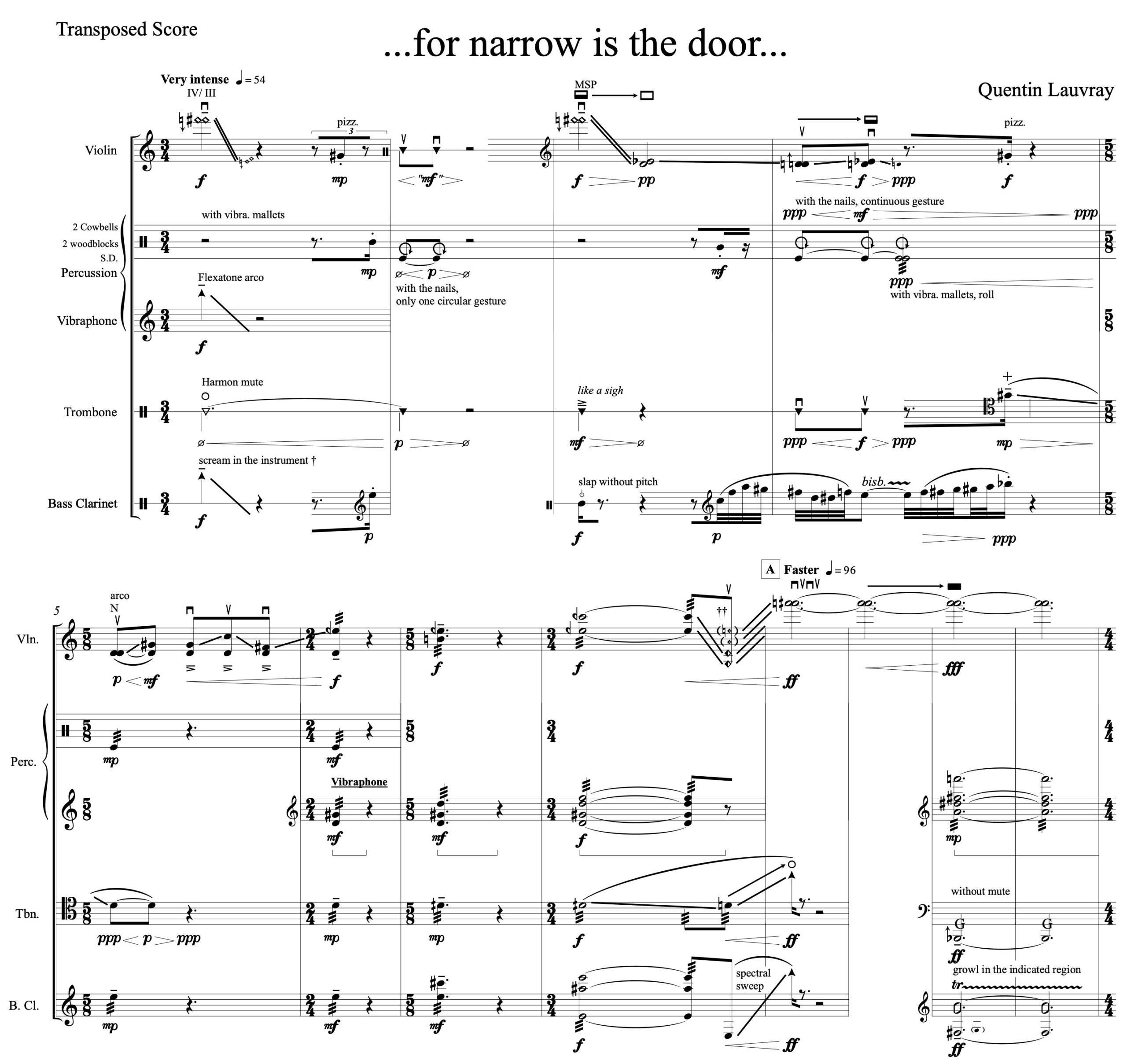 Figure 2: Quentin Lauvray, …for narrow is the door…, mm. 1–12.
Media 1: Audio excerpt of Quentin Lauvray, …for narrow is the door…, mm. 1–12. Listen to Media 1.
The tremolo chords in mm. 6–8 strike a balance between audibility of individual instruments and a partial integration of the ensemble into a single sonority (though again, not a full and inseparable blend). The shared tremolo articulation (though the effect is achieved through different physical actions by each musician) and use of several unisons (or near-unisons) helps to unify these chords. The excessive dominance of the trombone in the chord is avoided by the use of layered dynamics, with the trombone marked as an mp in mm. 6–7 against mf or f in the other instruments. In an archived draft of the score preface, the composer writes: “Even if it may seem unnatural or counterintuitive, following the layering of the dynamics is what will make the otherwise heterogeneous timbres merge.” In contrast, the loud chord in mm. 11–12 seems designed to steer away from integration towards the segregation of sound sources. Registral separation keeps the high, over-pressured violin dyad distinct from both the vibraphone chord and the “growling” trombone and bass clarinet (whose similar timbres combine together in the low register). Lauvray also uses layered dynamics to keep the tremolo vibraphone in the middle register appropriately balanced with the other instruments: it is marked only mezzo piano but can still be heard clearly. While these strategies are largely aimed at maintaining the audibility of individual instruments in the chord, the ensemble is nonetheless kept together to a degree by similarly harsh and irregular modes of articulation and sustain. The instruments come together in a shared timbral territory defined by roughness, granularity and spectral complexity.
Figure 3 is a score excerpt from a few measures later in the piece. The motion-based gestural integration that marked the start of the previous excerpt is largely absent in this more static passage, particularly the sustained sonorities starting in m. 20: here, we could speak instead of textural integration, with the four instruments contributing to a complex and transforming texture. Gestural integration does, however, reappear fleetingly with the combined violin and flexatone glissando at the end of the excerpt (m. 23).
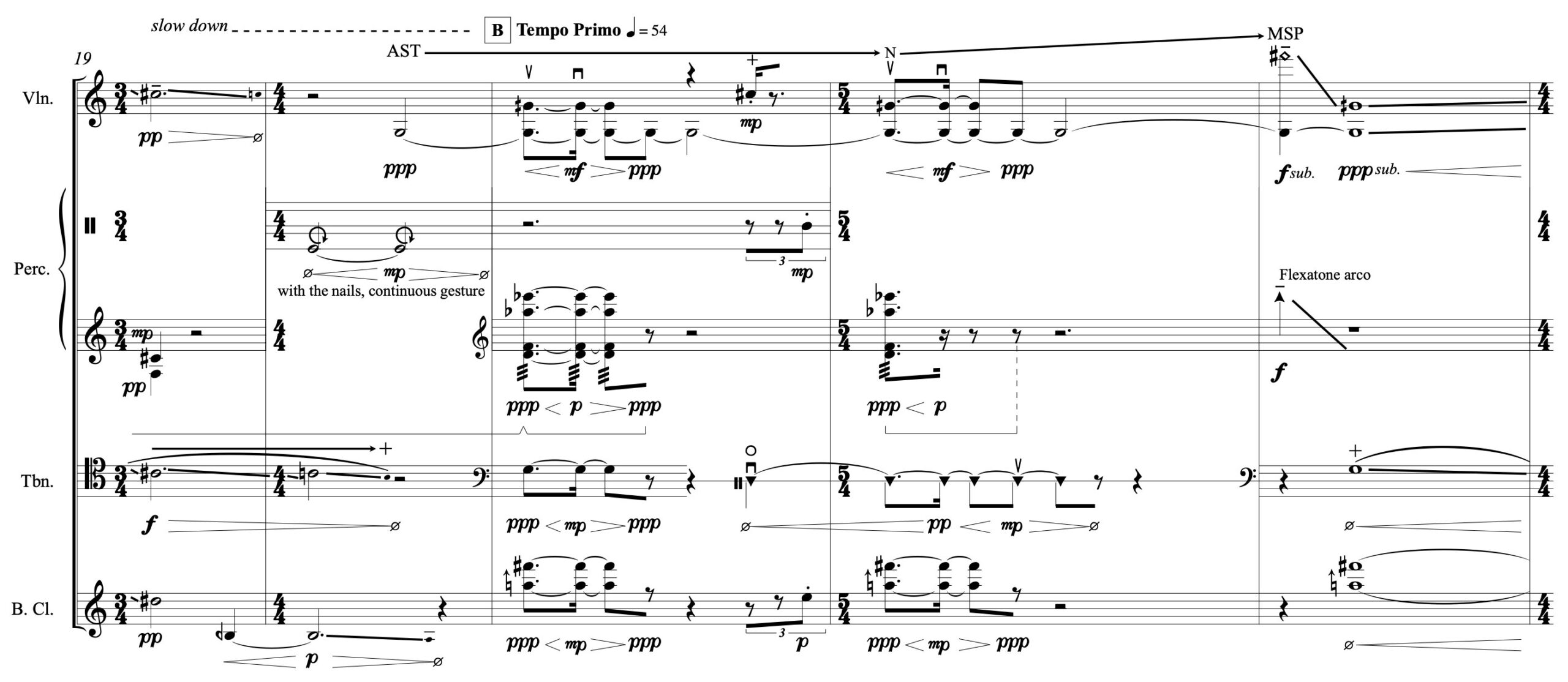 Figure 3: Quentin Lauvray, …for narrow is the door…, mm. 19–23.
Media 2: Audio excerpt of Quentin Lauvray, …for narrow is the door…, mm. 19–23. Listen to Media 2.
Unlike the first excerpt in Figure 2, the instruments in Figure 3 share many common pitches, contributing to the increased perception of blend among instruments. These blends usually augment the timbre of the violin rather than creating a new emergent timbre. There are identical pitches linking violin and trombone (G3), and violin and bass clarinet (G-quarter-sharp4, the lower note of the multiphonic in this transposing score). In the pitch domain, this quartertone-augmented octave might also be heard as contributing to a kind of integration: Alfred Cramer (2003) has argued that in terms of auditory stream analysis, the augmented or diminished octave in early twentieth-century music “may be said to fuse, but in a different manner from the fusion of traditional consonances” (13). While not fusing due to harmonicity and shared partials as would a perfect octave, the many nearly coincident partials and “the difficulty of perceptually resolving individual tones in these highly masked intervals is a substitute for fusion” (15) in these altered octaves. Cramer further observes that the masking caused by nearby but non-identical pitches “can unite several tones into a single perceptual object” (15).
The layered dynamics of the measure 21–22 chord help to keep the violin (mezzo forte at the peak of its hairpin) in the orchestrational foreground. The vibraphone is marked at just piano, and the potentially problematic trombone is kept under control by the use of a harmon mute and the shift to an unvoiced white noise “breath” effect in measure 21, which easily merges with the airy tones of the clarinet multiphonic and the faint noise of the violin bow. Here again, the instruments seem to seek a common timbral effect, a shared “zone” or timbral territory that encourages hearing these instruments as a single percept. The violin is at the centre of this timbral territory, with other instruments approximating its sound within the limits of their own timbral palettes.
In addition to gestural integration, Lauvray also describes (in an interview conducted in 2020 near the end of the CORE seminar) the use of registral separation as a way of ensuring the audibility (i.e. segregation) of each instrument, the importance of layered dynamics (i.e. different dynamics in each instrument) for achieving the desired effects, ways to create an effect of textural integration (already a grouping effect in McAdams et al.’s TOGE), and lastly a notion of a timbral territory or shared zone in which different instruments can contribute similar timbres to create a cohesive, integrated effect.8This notion has resonances with Rebecca Saunders’s description of “timbral palettes” in her music (Hasegawa 2026). In the 2020 interview, Lauvray was asked specifically about two issues: balance (that is, the audibility of each instrument in the ensemble) and blend (the perceptual fusion of instruments, conceived by McAdams et al. 2022 as a kind of concurrent grouping).
The question of balance arose in the context of the potential imbalance of the quartet (in terms of power, sonic presence, and volume already noted above). Lauvray responded:
To be honest, the big problem is the trombone. Well, the trombone on one side and then the violin on the other, because the “spectral spread” of the trombone is very large when it doesn’t play with a mute. Same for the vibraphone, while the violin is more a sustained sound, a point in space. The trombone, very rapidly, can swallow up the violin entirely! Same for the vibraphone. The clarinet, that depends on the registers.9« Soyons honnêtes, le gros problème est quand même le trombone. Enfin, le trombone d’un côté puis le violon d’un autre côté, parce que le “spectral spread” du trombone est très grand quand il n’a pas de sourdines. Pareil pour le vibraphone, tandis que le violon est plus un son tenu, un point dans l’espace. Le trombone, très rapidement, peut manger le violon sans aucun souci. Pareil pour le vibraphone. La clarinette, ça dépend des registres. »
He proposes a few possible solutions to remedying the potential imbalance of the trombone and vibraphone in relation to the other instruments. One possibility involves transforming the spectrum of the trombone and/or the vibraphone. One could specify particular playing techniques, “different mallets for the vibraphone, and mutes for the trombone.” An alternative to transforming the sounds themselves involves the careful deployment of the instruments into different registers or functional (perhaps even gestural) roles to encourage separation and resist fusion:
Another way to avoid the problem is to separate the instruments into different registers, and to ensure that the spectral energy of the trombone isn’t in the same zone where the other instruments play. I think that if one gives different roles, different functions to the instruments, it’s easier to separate them, to hear them in a clear way because they’re doing different things. Evidently, that gives more relief to the activity, while if they do something very similar there is a much greater risk of fusion.10« Une des solutions serait de changer le spectre du trombone ou du vibraphone, avec ou des modes jeux, différentes baguettes pour le vibraphone et avec des mutes pour le trombone. Une manière aussi d’éviter le problème, c’est de séparer dans les registres les différents instruments, et de s’assurer que l’énergie spectrale du trombone ne va pas être dans la même zone que là où les instruments vont jouer. Je pense que si on donne différents rôles, différentes fonctions aux instruments, c’est plus facile de les séparer, de les entendre de manière claire parce qu’ils font des choses différentes. Forcément, ça va donner plus de relief à … Continue reading
In other situations, though, a sense of perceptual fusion might be a compositional desideratum. The same features of the ensemble that make balance challenging also hinder the achievement of blend. Lauvray discusses the idea of “overlapping timbral territories” between instruments, with two contrasting examples:
I think that it’s easier and more effective to think of the timbral territories first, [than] to think how the instruments could direct themselves towards this territory. A very simple example is sustained white noise. One could have the trombone and clarinet blowing tonelessly, the violin could play on the bridge creating a thin white noise, even the vibraphone with some aluminum foil played arco, very soft, so the foil vibrates. All the instruments will have a better chance of fusing due to their characteristics. They all have this very “noisy” quality. Inversely, for a very metallic noise, which crunches a bit like a thundersheet being torn apart, one could imagine a kind of spectral glissando on the clarinet, for the violin something like a low note with a high harmonic, sul ponticello with lots of bow pressure, so that there’s both a very sharp high sound and also a granular aspect in the low register which slides a bit, with a chain on the vibraphone, things like that.11« Je pense que c’est plus facile et plus efficace de penser les territoires timbraux d’abord, puis de penser comment ces instruments peuvent pointer vers ce territoire. Un exemple très simple, c’est le bruit blanc; du bruit blanc tenu. On pourrait avoir le trombone qui souffle, la clarinette aussi, le violon pourrait être sur le chevalet, qui joue un bruit blanc filé, même le vibraphone avec du papier aluminium à l’arco, très faible, pourrait faire vibrer le papier aluminium. Tous les instruments vont avoir plus de chances de fusionner de par leurs caractéristiques. Ils ont tous ce côté très “bruiteux”. À l’inverse, un bruit très métallique, qui se … Continue reading
The two “timbral territories” described here represent very different kinds of concurrent grouping. In each case, Lauvray describes an imagined timbral archetype that defines the territory, then suggests potential sounds within each instrument’s “palette” (to adopt Rebecca Saunders’ term) that fit within that territory or zone. In many ways, this grouping is similar to the Gestalt Factor of Similarity, the tendency to group together objects that have similar characteristics; one could also think of it as an association of sounds by proximity in timbre space. Lauvray describes how conceptualizing the features of the zone is a good starting point for achieving blend: “it’s easier to think of the zone that you’re trying to reach and to see how the different instruments can meet each other in the same zones… rather than starting from nothing and saying ‘I’ll try to make these blend.’”12« Je pense que c’est plus facile de penser la zone que l’on cherche à atteindre et de voir comment les différents instruments peuvent se rejoindre dans les mêmes zones plutôt que de partir du vide et de se dire “je vais essayer de les faire blender”. »
Pedram Diba, Reaching for the Unreachable Point of Desire
Prior to CORE, Pedram Diba typically composed by following a recursive process: planning, taking a step back to evaluate, writing, taking a step back to evaluate and reassess, revising, and repeating. The McGill CORE seminar afforded a more hands-on experience: putting an idea down on paper or expressing it verbally, exploring the sound with the ensemble, listening, spending time away from the ensemble developing the idea, and coming back with a more refined version for further exploration.
In his final interview for the seminar, Diba mentioned the influence of Gestalt principles on his piece Reaching for the Unreachable Point of Desire13Score, audio, and video of the piece are available here: https://timbreandorchestration.org/research-ensembes/compositions/diba/reaching-for-the-unreachable.:
For perceptual effects, one thing that was mentioned was the Gestalt theory, last year, and I looked further into it myself, and that was very helpful, because I didn’t know the theory before that, and it opened up my view to a new way of thinking…
I keep saying it, but the Gestalt theory, that is going to stay with me. (2020_02_21_Diba_Interview_Phase2)
Gestalt theory, as used here, refers to a tradition of perceptual psychology concerned with how discrete stimuli are organized into coherent wholes (e.g., Wertheimer 2012).14For more on Gestalt theory see Smith (1988). While the TOGE acknowledges the influence of Gestalt psychology on music theory and draws on grouping factors such as proximity, the tendency to group objects that are close together in space or time into wholes, and similarity, the tendency to group elements that are similar in some domain (e.g., timbre) into wholes. The TOGE does not, however, systematically map Gestalt factors to orchestral effects. By contrast, Albert Bregman posits that “all the Gestalt principles of grouping can be interpreted as rules for scene analysis” (1990, 24). Therefore, we view Gestalt factors as explanations of acoustic organization that give rise to orchestral grouping effects, as named in TOGE.
Using the Gestalt factors as compositional inspiration connects directly to Diba’s original conception of his composition. In the seed idea presentation in September 2019, he spoke of striving for the instruments to make the same “sound,” not as in instrumental fusion (i.e., perceptual blend) but rather a more heterogeneous entity. Diba’s sonic goal would be for a listener to be able to hear individual instrumental identities but perceive that they “belong to the same thing” (2019_09_20_Composers_SeedIdeas, 40:46).15For a complementary perspective on how composers achieve this sonic goal see Rosner (2026). For a visual example of how Diba was thinking about ensemble integration, Figure 4 provides one of the early sketches he brought into the ensemble.
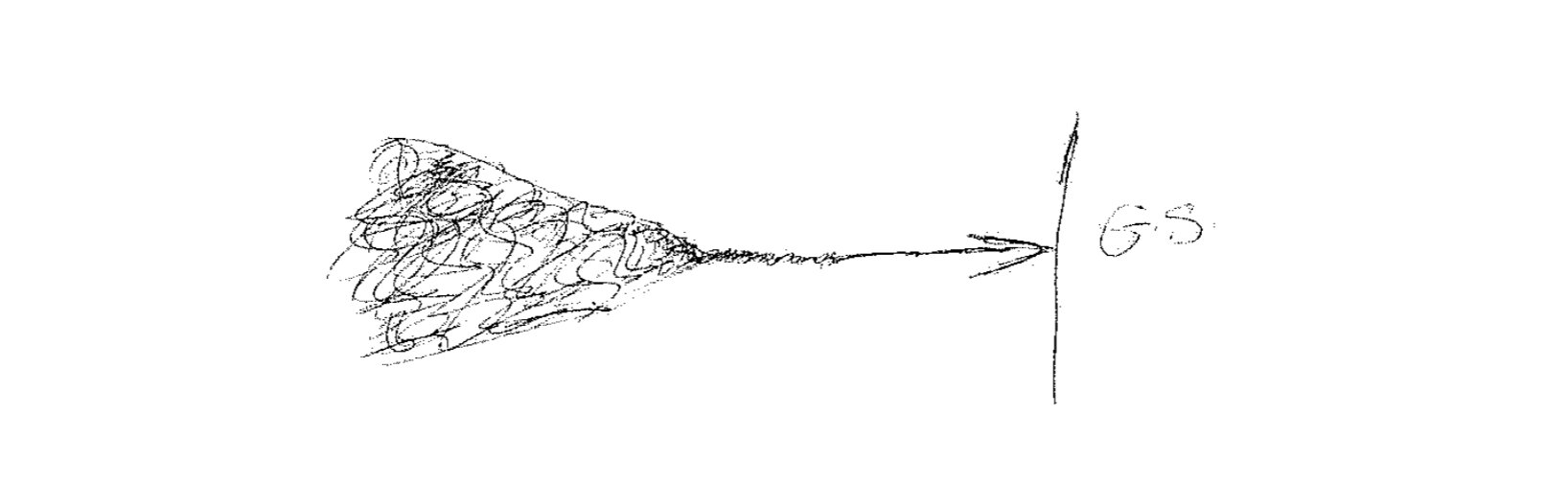
Figure 4: Diba’s sketch, presented to the CORE seminar at McGill on November 1, 2019.
According to the taxonomy taught over the course of the seminar—now codified in McAdams et al. 2022—Diba was describing heterogeneity at the concurrent grouping level, but integration at the sequential grouping level. This links TOGE’s concurrent/sequential categories to Gestalt-described acoustic drivers. In the image above, a viewer can pick out the individual lines that make up the wedge shape at the left-hand side of the image, but as the wedge compresses, the individual lines converge into a blur.
Based on other materials collected during the process and subsequent conversations with the composer, Diba strove for ensemble cohesion by adhering to several Gestalt factors: (1) factors of proximity and similarity (Wertheimer 2012) and (2) factors of generalized common fate, in which elements are grouped through coordinated change, and synchronicity, in which simultaneity promotes grouping (Wagemans et al. 2012). Diba also employed the strategy of overloading the listener with sonic information as a grouping mechanism. (Here, we highlight Common Region and Synchronicity as factors not explicitly catalogued in TOGE.)
Measure 4 contains a condensed version of the principal gesture of this piece—a full ensemble undulation anchored together by pitch proximity (Figure 5). This gesture occurs several times throughout the piece (see mm. 14, 24, 72, 78, 124), but can also be heard in more fragmented forms, for example in the first measure. Despite the timbral heterogeneity of this eclectic ensemble, all four instruments play in the range of a diminished third between G¦H4 and B¢Ú4. By keeping all four instruments within a specific range, hovering around a focal pitch (A4), Diba encourages the listener to hear the four parts as components of a single, integrated sonic gesture; what McAdams et al. (2022) refer to as stream integration: the perceptual connection of a sequence of auditory events into an auditory stream (McAdams et al. 2022).16Unlike the gestural integration in Lauvray’s mm. 8–9 (see Figure 2), which uses similar gestures to integrate quite different pitches, Diba’s m. 4 has different kinds of motion that are tied together primarily by their common range. Although the timbral dissimilarity allows each instrument to maintain its identity, the close proximity in pitch space leads the listener to hear all four instruments as participating in one shared musical stream. Note that Diba does not orchestrate any of the instruments in unison with one another. Each instrumental voice retains its individuality, yet the proximity to one another, in shared pitch space, assists the listener in grouping them together. Consequently, while consistent timbre is usually a requirement for stream integration, McAdams et al. (2022) write that register, dynamics, synchronous playing, and parallelism also foster perceptual integration.
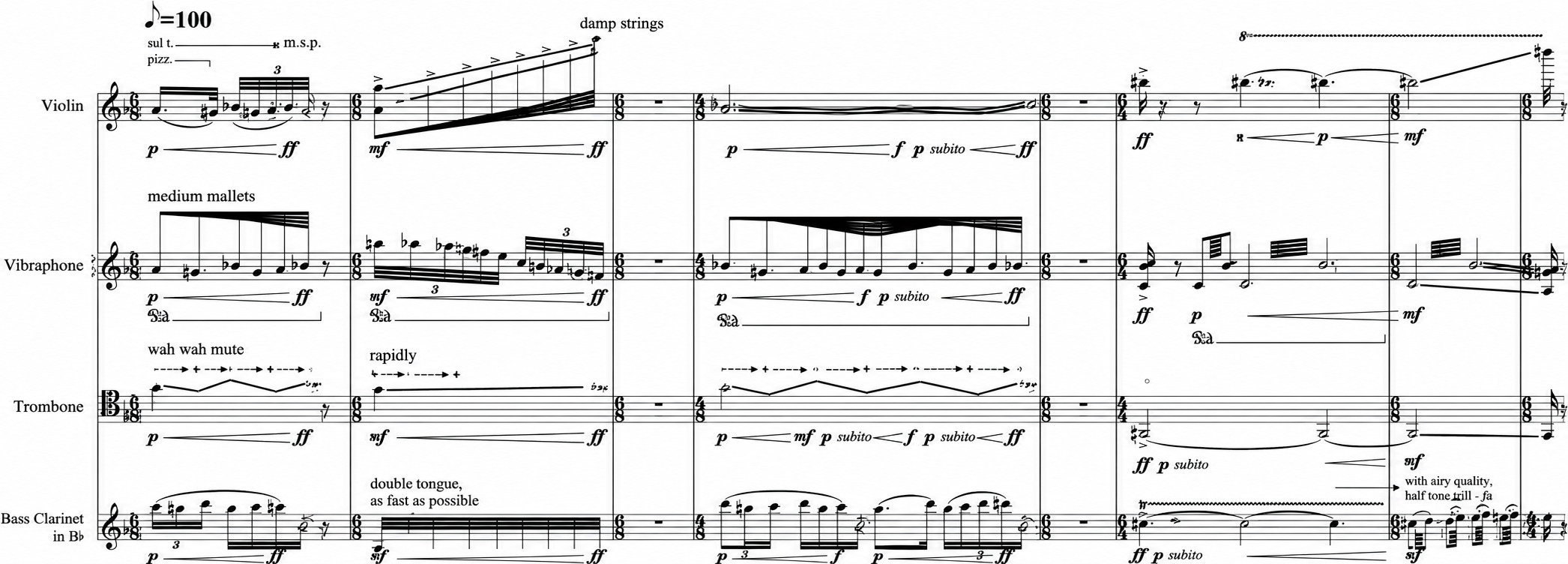
Figure 5: Diba, Reaching for the Unreachable Point of Desire, mm. 1–7.
Media 3: Audio excerpt of Diba, Reaching for the Unreachable Point of Desire, mm. 1–7. Listen to Media 3.
Common register may be understood in conjunction with the factor of proximity, but Gestalt theorists have since proposed the factor of common region (Palmer 1992). According to Wagemans et al., “the structural basis for grouping by common region appears to be that all the elements within a given region share the topological property of being inside of or contained by some larger surrounding contour” (2012, p. 1181). Unlike the factor of common fate, where grouping is achieved by shared motion or change, grouping by common region occurs when objects are within the same bounded space. In other words, common fate is dynamic and common region is spatial. Unlike the factor of proximity, such a grouping may occur even when elements are relatively far apart; so long they are enclosed within the same boundary. In musical terms, a registral band can function analogously as such a bounded perceptual domain: tones heard within the same register may cohere as a group despite temporal separation or intervening material. Here, again, Diba has placed the first appearance of this gesture between material with much larger registral compasses (end of m. 2 and beginning of m. 6), so that the gesture’s recurrence is heard not simply through local proximity but through its occupation of a shared registral space.
The most complete version of the principal gesture occurs at measures 78–80 (Figure 6). Diba confirmed (in a follow-up conversation after the course had ended) that this was the first thing that he wrote for this piece. By the time a listener hears measure 78–80, they have heard variations of this gesture at measures 1, 4, 14–15, 24, 70, and 74. Not only is Diba utilizing the aforementioned Gestalt factors to integrate this musical material into a cohesive gesture, he is also teaching the listener to group these heterogeneous timbres together—for more on repetition as a Gestalt factor, see Gottschaldt (1938). Even if listeners are unable to hear these proximate but timbrally dissimilar elements as an integrated entity, they likely learn to perceive them as familiar and inextricably intertwined.
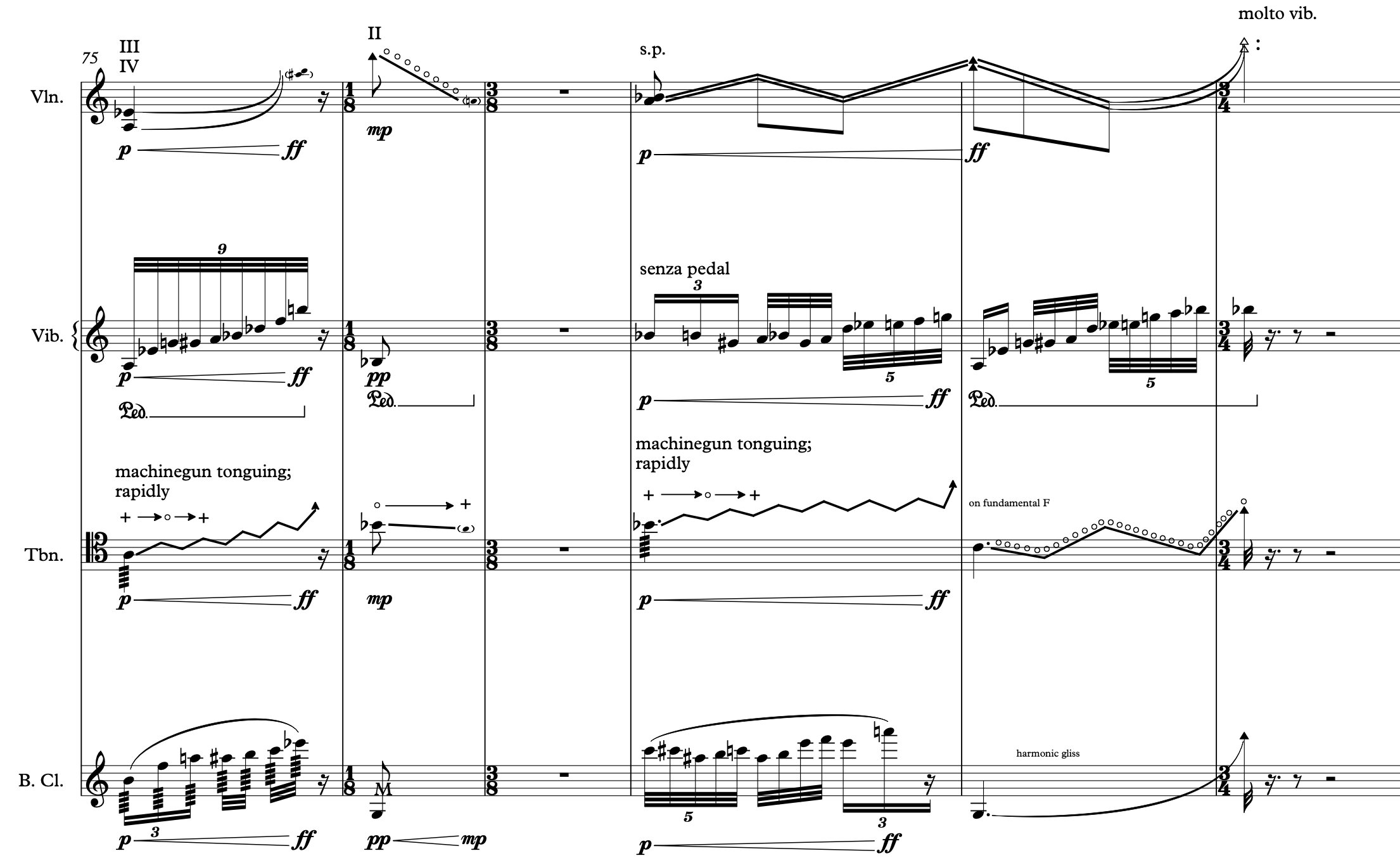
Figure 6: Diba, Reaching for the Unreachable Point of Desire, mm. 75–80.
Media 4: Audio excerpt of Diba, Reaching for the Unreachable Point of Desire, mm. 75–80. Listen to Media 4.
Here we can also see the second strategy, the factor of common fate. The factor of common fate, the perceptual tendency to group objects that change together in location or that move together, can be heard in the coordinated, dynamic swells orchestrated by Diba. These synchronous changes in dynamics help create the impression of motion in the same direction among all instruments. In other words, it may sound as if all the instruments are moving closer to the listener. In this instance, the synchronized swell is not only a grouping mechanism but also a way to create an “expansion of timbre” (McMullan-Glossop 2017, p. 520). By the end of the gesture, the ensemble has transitioned from one timbral version of the sonority to another. Through orchestrating the dynamics of the ensemble, Diba provides the listeners with a means of connecting these timbrally distinct sonorities.
Interestingly, synchronicity has been deemed a Gestalt factor (Alais et al. 1998; Lee and Blake 1999). This factor describes the tendency for elements that change simultaneously to be grouped together, even if the changes are in opposing directions. The factor of common fate, or generalized common fate, requires that the changes occur in the same direction (Wagemans et al. 2012). The factor of synchronicity can help explain how Diba can compose a gesture such as those in measures 2 or 126–127 (Figure 7) where certain instruments continuously ascend, while others continuously descend, yet a listener perceives a unified gesture. The instruments need not change in the same direction—what McAdams et al. (2022) refer to as parallel motion—in order to integrate. Instead, Diba orchestrates the gesture such that the instruments change at the same time and this creates the impression of a unified expansion.
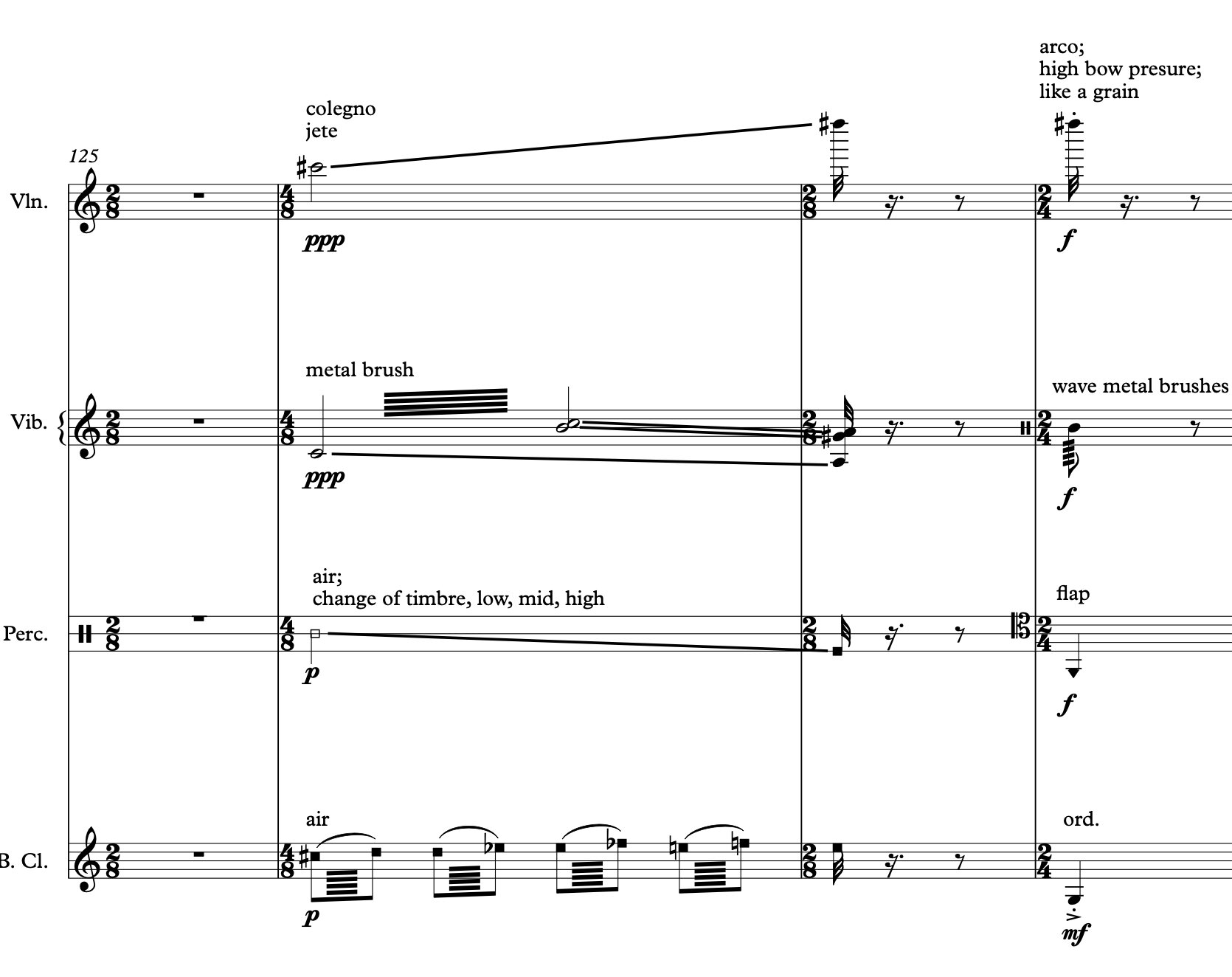
Figure 7: Diba, Reaching for the Unreachable Point of Desire, mm. 125–128.
Media 5: Audio excerpt of Diba, Reaching for the Unreachable Point of Desire, mm. 125–128. Listen to Media 5.
So far, the perceptual analysis has focused primarily on excavating the Gestalt factors that underpin ensemble integration; however, Diba’s final strategy is that of cognitive overload. Diba, in almost a sound mass fashion, expressed the notion that chaos is, to a certain extent, a grouping mechanism. In the same vein, spectral density—tight clustering that packs partials into the same auditory channels—also promotes fusion (McKay 1984). McAdams et al. (2022) discuss a specific version of this phenomenon when describing punctuated timbral emergence. This concurrent grouping occurs when, “there is not enough time to aurally analyze the instrumental constituents” of a sound (4.12). In contrast to the temporal limitations of auditory cognition, Diba relies on what David Huron (2001) calls the principle of limited density; what Descœudres (1921) called the un, deux, trois, beaucoup phenomenon. Huron surmises that if a composer desires perceptual independence of parts, they should keep the number of simultaneous voices at three or fewer.
In addition to overloading the listener with four auditory streams to track, the chaotic internal motion of the composite gesture helps to create the perception of indeterminate sound sources. The overload is also, in part, assisted by the open notation that Diba employs throughout the piece. With the occasional exception of the bass clarinet and vibraphone, Diba generally chooses to notate this gesture in a loose fashion. This decision grants the performers more agency than if one were presented the same gesture rendered in incredibly precise notation. By giving just enough information to get the desired sound, performers were given plenty of space to shape their own artistic interpretation. Diba also uses open notation in several other sections of the piece (e.g., mm. 40–41 in Figure 8). We posit that the agency garnered from the lack of specificity encourages the performers to listen to one another; paying less attention to the score and internalizing the gesture. They become able to focus less on accuracy or precision and instead on how to relate their part to the rest of the ensemble.
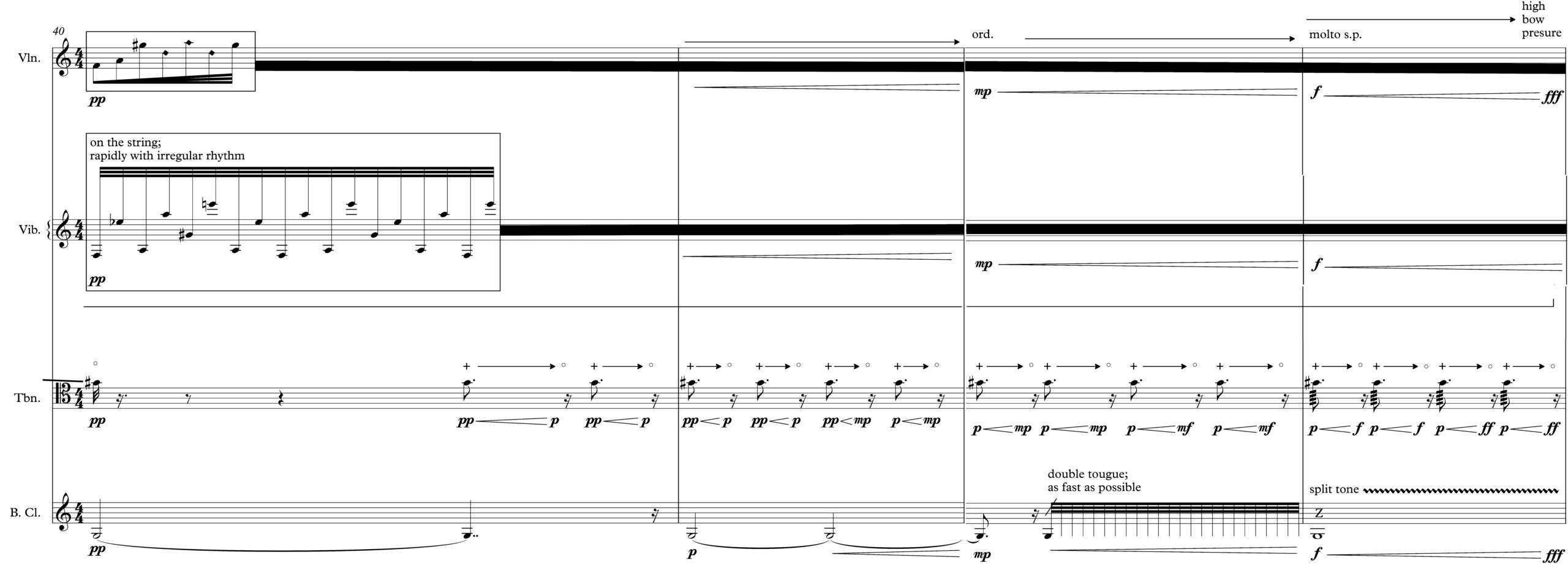
Figure 8: Diba, Reaching for the Unreachable Point of Desire, mm. 40–41.
Media 6: Audio excerpt of Diba, Reaching for the Unreachable Point of Desire, mm. 40–41. Listen to Media 6.
This idea was expounded upon by trombonist Ryan Cass in his final interview. When asked about how CORE would reflect his future music making, Cass responded,
…it makes me think a lot more about, not the music in terms of notes and rhythms, I’m trying to think more about gestures and […] the kind of sounds that they want me to create and the ideas they want me to create, and how I can create them in ways which are unconventional, maybe a little improper to what we would consider in the classical trained world. (2020_02_21_Cass_Interview_Phase2)
By using shared vocabulary to describe sound, workshopping gestures, and providing open-ended notation, Diba built up a conceptual grouping in the minds of the performers in addition to the perceptual ones he aims to achieve for listeners. By being a part of the creative process, the performers learned to integrate themselves into a cohesive unit. Both listeners and performers are ultimately able to hear the unique voices of the instruments, while perceiving/conceiving that they “belong to the same thing.”
Alex Blank, Flow
The third and final piece produced for the first CORE seminar at McGill was Alex Blank’s Flow.17Full score, audio, and video available here: https://timbreandorchestration.org/research-ensembes/compositions/blank/flow. The piece features lower dynamics and longer, dovetailed phrases relative to the other two pieces, and stands out among the three in two particular ways: first, its approach to blend and integration has more to do with subduing and manipulating the “ordinario” instrumental timbres to bring them close to one another and adding grain to create textural associations, and second, its considerable use of preparations for the instruments to achieve these different timbral shades. Complete instrumental blend (instrumental fusion) rarely happens, and overall the orchestration allows listeners to hear the instruments individually. Instead of blend, the piece is mostly characterized by the instruments’ integration into different layers across different segments.
In contrast to the gestural integration explored in the previous two pieces discussed here, in Flow onsets are rarely synchronous, off-set by different subdivisions, nor do marked end gestures (dynamic swells) happen at the same time when they are used. There is coordination, though. Segments in the piece, and the instrumental layers within those segments, are associated via similar types of activity and texture—slight pitch bends, added grain, and dynamic crescendo and decrescendo are used to form contrapuntal phrases which set instruments together and apart in the orchestration through sonic character rather than parallelism and tightly synchronized common fate.
Going through the main features of the instrumental parts reveals more of how these integrations are achieved.
Clarinet
The most striking feature of the clarinet part is the use of two different reeds throughout the piece, one made to be darker in timbre, and the other brighter. The foreword to the score gives detailed instructions on how to construct the two from reed blanks, including diagrams and links to sound examples. The diagram is shown in Figure 9.
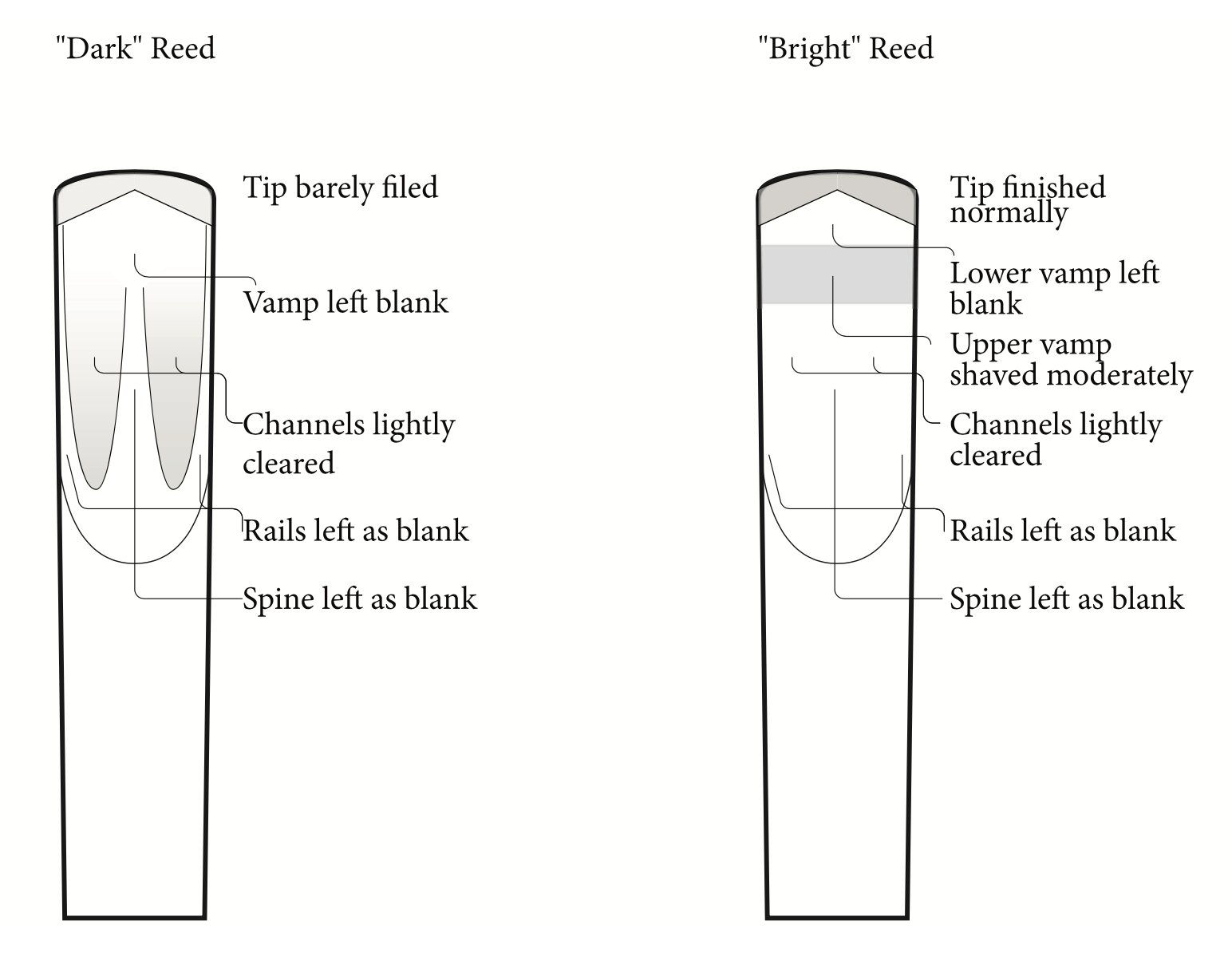
Figure 9: Blank, Flow, excerpt from foreword to the score.
The two reeds and the changes between them split the work into three sections. The dark reed is used at the beginning of the piece, then in measure 58 the bright reed is used, until measure 114 when the dark reed is used again until the end of the piece at measure 183. This creates a rough division of ⅓ dark–⅓ bright–⅓ dark throughout the whole piece. This kind of timbre manipulation seems to be an attempt to bring the timbres of the clarinet and trombone closer together at times, allowing for moments of blend and integration, as they explore different shades of their sustained pitches’ brightness, as we can also see in the trombone part.
Trombone
The trombone part features a significant use of mutes throughout the piece, as well as instructions on how to construct two of the mutes out of polystyrene foam,18In the recording available on https://timbreandorchestration.org/research-ensembes/compositions/blank/flow the trombonist and conductor decided to use traditional mutes to achieve a similar result within the constraints of that concert production. similar to the detailed clarinet reed construction instructions including diagrams and sound examples. Beyond solving the issue of balance with the rest of the ensemble, the use of highly specific mutes allows Blank to shape the timbre of the instrument to a high degree of detail. The idea to control the trombone’s timbre through muting and filtering in this way is evident in Blank’s later interview. Blank mentions that the use of off-stage brass in orchestral settings prompted him to think about how to “denature the sonic profile of the instrument to a listener.” The closer timbral proximity achieved by these manipulations seems intended to allow the instruments to better integrate into layers and auditory streams. Later in the interview, Blank added the following:
So for me, that has really been the big problem of orchestration, sort of denaturing the trombone, both in relative amplitude and in just the sheer brassy quality of the instrument. More bringing it in line to match the others, though there is a little bit of bringing the others to match it. But that, I think, has been the big problem of orchestration, within the specific context of this project.
Different trombone mutes are used at different sections in the piece to control the overall timbre, as follows: the first of the self-constructed mutes, the large polystyrene mute, is used in the beginning, followed by a plunger mute from measure 39, no mute from measure 44, back to the plunger mute at measure 53, back to no mute at measure 69, then introducing the small self-constructed polystyrene mute in measure 83, to no mute again in measure 121, and ending with the large polystyrene mute again from measure 146 to the end of the piece at measure 183.
This larger structure, indicating which mute to use when, is then broken into smaller structures that further control filtering of the trombone’s sound within the phrases. The degree of opening for each mute is dictated by a specific notation above the staff, indicating which of 5 degrees of occlusion from open to closed to apply to the bell and/or mute at any given time, and when and how to move between these states. An example showing the different gradations of opening of a plunger mute is given below, from measures 60–62. These indications work for the polystyrene mutes as well, as they have an opening at their outer end.

Figure 10: Blank, Flow, trombone part, mm. 60-62.
Media 7: Audio excerpt of Blank, Flow, trombone part, mm. 60-62. Listen to Media 7.
Blank also uses microtonal pitch indications throughout the piece. One noteworthy utilization of pitch happens when the trombone and clarinet do achieve similar timbres and play in the same register, and where pitch differences are used to produce beats that add grain to the winds’ parts. In measures 72–74, shown below, the clarinet and trombone are instructed not to match pitch with the other at specific entrances where their pitches are close to one another. The relative proximity in pitch and timbre allows the two instruments to fuse momentarily into one auditory stream, but the maintained difference in pitch produces a grain through the resultant beats, which changes the quality of their combined sound.
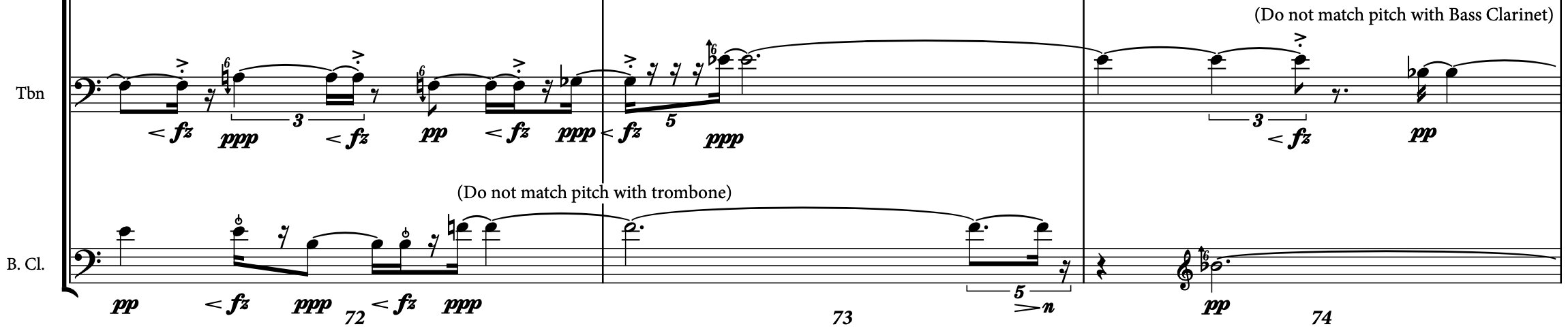
Figure 11: Blank, Flow, trombone and clarinet parts, mm. 72-74.
Media 8: Audio excerpt of Blank, Flow, trombone and clarinet parts, mm. 72-74. Listen to Media 8.
Percussion
The percussion part utilizes a prepared vibraphone and snare drum to achieve different roles. It combines with the winds, hiding behind them, by using soft yarn mallets on the vibraphone. Pitch bends on the vibraphone matching those of the other instruments are achieved through a rubber mallet applying pressure to the bars being played. A tremolo of varying speed with soft or very soft mallets is used to add varying grain. These all allow the vibraphone to combine with the winds’ texture at different times. Examples of all of the above already happen within the first 7 measures of the percussion part, shown in the example. At other times, the percussion part stands separate from the winds’ sound world, such as when using the snare drum to produce noisy sounds that connect to the violin bowing noises. For example, starting in measure 30, the percussionist is instructed to play the drum with “snare on[,] wire brush[,] with marbles laid upon drumhead”; or in measures 69-80, a rubber ball is dragged with varying pressure on the drum to produce a wailing gesture. These different tactics for shaping the percussion timbres to be more or less similar to the other instruments allow the percussion to achieve integration with, or segregation from, different layers of the orchestration throughout the piece.
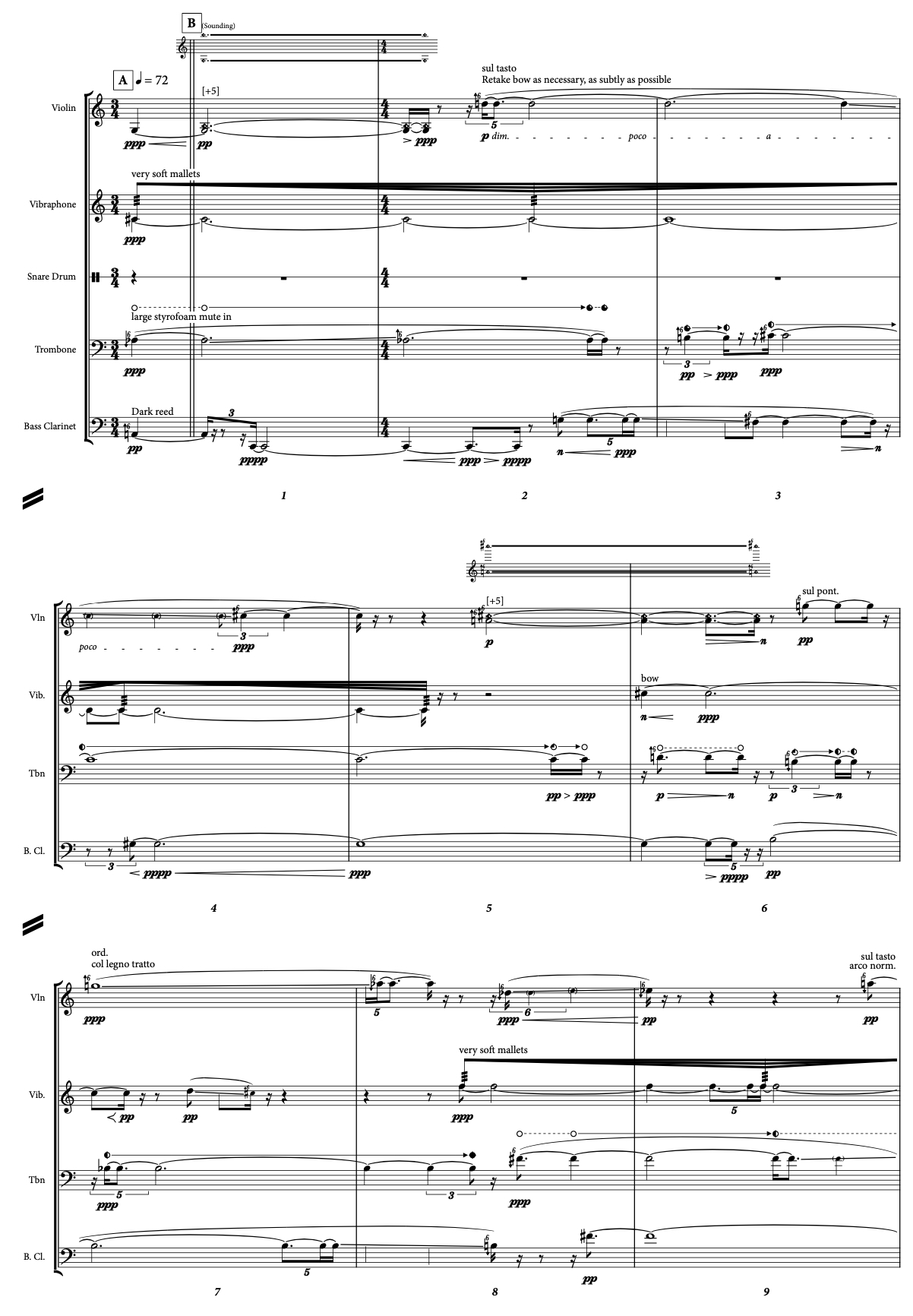 Figure 12: Blank, Flow, mm. 1-7.
Media 9: Audio excerpt of Blank, Flow, mm. 1-7. Listen to Media 9.
Violin
The violin part has primarily to do with overtones and the sounds of bowing—filling the high register as a separate distinct background layer for most of the piece. Variations in the types of overtones produced, modulations of bowing speed and pressure producing “flutter” effects, as well as sections of applied overpressure, all produce variations in the grain of the sound. Some of this can be seen in the example below, measures 140-142, for which Blank writes in the foreword to the piece: “[…] occu[r]rences where a further ‘flutter’ indication is given […] these are to be performed primarily using an alternation of bow speed and pressure, and nodal finger placement.”
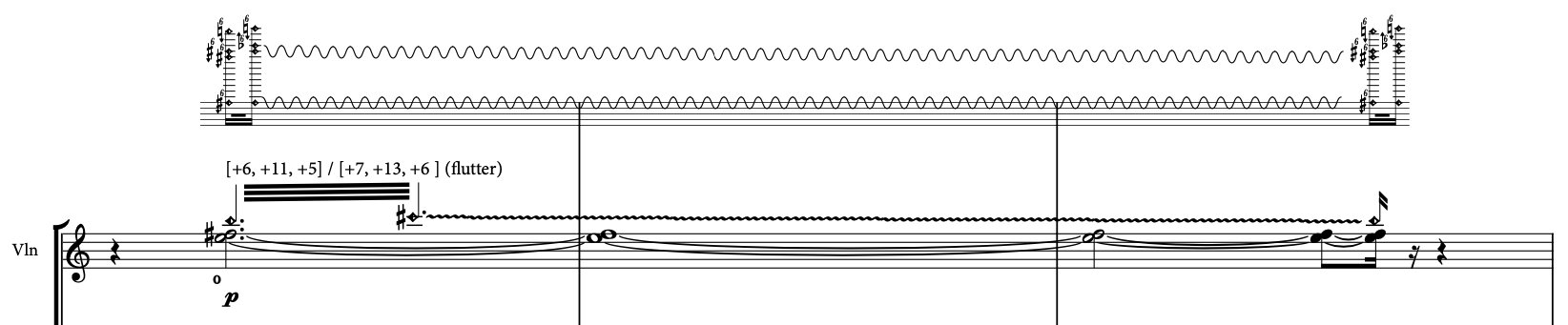
Figure 13: Blank, Flow, violin part, mm. 140-142.
Media 10: Audio excerpt of Blank, Flow, violin part, mm. 140-142. Listen to Media 10.
Work with grain seems to characterize this piece by Blank. In his interview, Blank mentions grain as a preoccupation: “At least for me, thinking about how we all sort of gravitated to the idea of grain, and I gravitated towards that as well…”. Blank’s use of filtered and subdued instrumental sound with grain added in different moments by various means to each of the instruments points to an integration and segregation strategy revolving more around texture, as opposed to gesture and/or fusion. While blend and fusion happen, they are very rare in this piece, and a confusion of identity between the instruments’ “denatured” sounds occurs more often, especially when little grain is added; it is at these points that the strongest integration of layers happens.
Notation and communication
One topic for consideration that arose while analyzing the pieces we discussed is the ways in which the composers in this project communicated their sonic goals to the performers. Because this consideration runs parallel to all three pieces, it is discussed here in its own section. To briefly recap, the strategies for different types of grouping and integration identified in the examples reviewed so far include: instrumental blend (timbral augmentation/emergent timbre), textural integration, gestural integration, masking, timbral overlap, and sound mass. The difficulty, however, is that while we were able to verify the actual sonic goals of the composers through reports, interviews, or session recordings collected as part of the seminar documentation work, it would be challenging to identify these sonic goals without that information. An independent interpreter of this music would have to rely solely on the notation and text of the score.
Looking at the final scores’ front-matter descriptions and notated music, as well as drafts, we can notice different ways the composers approached communicating their sonic ideas.
Open, goal oriented
Composers sometimes write instructions that describe the sounds they wish to hear and that eschew direct reference to instrumental technique, leaving it to the performers to produce the intended sound. This can be more or less specific, such as “play a harsh, loud sound” or “play a dark G4 and blend with the trombone”. (These examples are not directly from the scores.) One notable example of this that came up in the early exploration phase of the seminar was Lauvray’s use of an audio score—an excerpt of a sound recording of a scream he wanted the musicians to imitate at various levels of abstraction. Amongst the final compositions, Diba’s was perhaps the most open and goal oriented of the pieces we review here, notating several gestures graphically with lines and curves suggesting trajectories with varying degrees of specificity in pitch and rhythm.
Detailed and controlled
Another approach to notation can be more focused on controlling the performance parameters directly, such as indicating the precise rhythm of a vibrato to be applied, or indicating the exact fingering to use to achieve a specific clarinet multiphonic. As an example of such detail-oriented instructions, Blank gave directions in his score about ways to prepare two specific trombone mutes, further adding detailed rhythmic instructions of when and how much to open and close these mutes to achieve various timbral manipulations.
This brings us to the duality of music notation as being applicable to both music-as-heard and music-as-performed, the simplest instance being guitar tablature notation as opposed to common music notation. An example is shown below, where the tablature notation specifies which strings and frets to use on the guitar to play a measure of music, whereas the pitch based notation specifies the resultant pitches only, letting the performer decide on their own fingerings. A lot of music notation falls somewhere in between the extremes, with some combination of both types of information being presented. These considerations are not new, but with the focus of our research on timbre and orchestration, additional parameters arise, such as fusion, blend, and integration. Traditional pitch-based notation does not address these well, if at all, and even current expanded musical practice can struggle with conveying these concepts. One solution does exist, more or less, in traditional notation practice; much like a melodic line for an instrument within an orchestral texture might have “solo” indicated above, which suggests that the player should modify their sound production to stand out from the ensemble, a similar approach can be used for other orchestral effects such as blend and fusion. But in order to do this, musicians need an agreed-upon vocabulary to describe these various phenomena—a shared dictionary of orchestral effects.
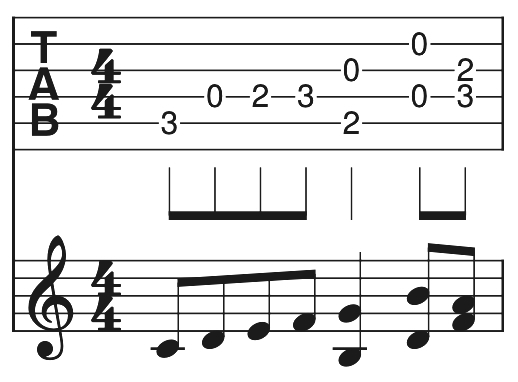
Figure 14: A sample measure of music for guitar, not from the pieces in CORE, written here in both tablature notation and common music notation.
Looking at the later interviews and recorded rehearsals conducted towards the end of the seminar, we can gain some insight into how the students approached and dealt with notation specificity and how a shared vocabulary provided by the seminar lectures played into this dynamic.
We asked about notation in the interviews. Blank described balancing simplicity and specificity as nebulous. He summarized the differences in approaches as notation adapting to the frame of the composer. When these issues were discussed with the performers, we noticed an openness to different notational strategies. The clarinetist for whom Blank wrote exacting reed replacement instructions, Elia Foster, seemed to appreciate both approaches. She gave an example of a hypothetical score that has a section in it with the simple instructions “insert grainy sound here” as both clear and engaging. At the same time, when asked whether she found any notation to be overly specific during their sessions, she replied no, and that specificity in instruction was useful. These two students’ responses point to flexibility around adopting any one notational approach over another.
Throughout the rehearsals, we observed frequent use of various terms learned in the seminar, to address timbral and orchestrational matters and clarify notated instructions. When looking at the scores in those moments, we identified notation that was suggestive of a certain orchestral effect or another; however, it seems that the vocabulary adopted by the composers and performers in conversation has not yet been absorbed into their notation practice enough for them to include the terms in the score itself. The notational approaches we did see still had an effect, though. For example, while there was no instruction on overall orchestral effect in Diba’s score, such as “blend with…”, we believe the more open graphical notation he used at certain points allowed the performers to free up more attention for the shared aspects of their gestures and achieve more cohesion where relevant, despite limited rehearsal time.
Conclusion
In this article, we have documented how composers in the McGill CORE Round 1 seminar applied and expanded ideas from the TOGE (Taxonomy of Orchestral Grouping Effects), with particular interest in integration of instrumental sounds. In addition to categories already present in the TOGE, they sought new approaches to orchestral grouping, including the notion of gestural integration. The unique format of the seminar allowed a number of innovations to emerge through discussions involving composers, performers, and mentors, ultimately suggesting new ways of conceptualizing the notation of orchestral grouping in musical scores.
It is important to stress that the goal of research at ACTOR and this paper in particular is never to prescribe how composers and interpreters should approach notation and orchestration. Instead, we would like to frame the next few thoughts as ideas to add to a shared collective toolbox of possible approaches.
The seminar’s main potential for contribution to the student-musicians’ practice with regard to the communication of ideas was the ability to specify sonic goals and musical intent more directly using the vocabulary they learned, whether this was used in a more open sonic goal-oriented approach or to augment detailed, specifically-notated performance instructions.
Blank made some observations in his final interview that sum up the responses of the other participants (both performers and composers) quite well. Describing the introductory lectures in the first weeks of the seminar, he commented that “By giving the performers the same vocabulary [as] the composers, we were all drawing from a similar dictionary. It allowed for more efficiency in expressing our various ideas.” Clear terminology that addressed sonic categories and orchestrational goals beyond the limits of traditional score notation was seen as an advantage. Discussing one of the taxonomies covered in the seminar, Lasse Thoresen’s Aural Sonology19Aural Sonology is a framework for analysing music-as-heard, developed by Lasse Thoresen with the assistance of others, which builds on and refines Pierre Schaeffer’s Typomorphology, adding a set of terms and associated graphical symbols which can be used to annotate waveforms, spectrograms, and/or scores. In recent years composers have increasingly explored its use to sketch out and describe musical ideas not captured as well by traditional notation, such as texture and timbre. The Aural Sonology project is documented at: https://www.auralsonology.com/ (2007), Blank observed that “We need to have an agreed upon vocabulary before we can start pushing any of these parameters to their extremes or drawing everyone into the centre of whatever map of sound we’ve created.”
Building on the positive reception of these vocabularies in the seminar, we believe presenting such ideas—the taxonomies seen in the TOGE and Aural Sonology, and concepts from timbre semantics research such as cross-modal analogies—could be beneficial to composers and performers searching for new ways to better communicate their timbral and orchestrational goals and discuss their interpretations. One future direction of research into orchestration pedagogy could be the evaluation of teaching these different vocabularies and theoretical frames and comparatively assessing their value for students engaged in creative orchestration tasks. While there is no intent to evangelize one vocabulary or the other, these initial successes seem to suggest that sharing these conceptual tools could help others as well. For musicians and teachers looking to potentially incorporate the taxonomies and concepts discussed above into their process, one of the main deliverables for the ACTOR project is an online, freely available reference—the Timbre and Orchestration Resource (TOR)20https://www.timbreandorchestration.org/.—which presents ACTOR research as well as materials for teachers and students.
Bibliography
Adler, Yuval (2023), “Expanding a Taxonomy of Instrumental Grouping Effects to Align with Contemporary Musical Practices,” in Proceedings of Timbre 2023, 3rd International Conference on Timbre, Thessaloniki, Greece, https://adler.audio/wp-content/uploads/2023/07/ADLER_timbre2023_paper_v2_2023May11.pdf, accessed 23 February 2025.
Alais, David, Randolph Blake, and Sang-Hun Lee (1998), “Visual Features that Vary Together Over Time Group Together Over Space,” Nature Neuroscience, vol. 1, pp. 160–164, https://doi.org/10.1038/414.
Bregman, Albert S. (1990), Auditory Scene Analysis. The Perceptual Organization of Sound, MIT Press.
Cramer, Alfred (2003), “The Harmonic Function of the Altered Octave in Early Atonal Music of Schoenberg and Webern. Demonstrations Using Auditory Streaming,” Music Theory Online, vol. 9, no 2, https://www.mtosmt.org/issues/mto.03.9.2/mto.03.9.2.cramer.html, accessed 23 February 2025.
Descœudres, Alice (1921), Le développement de l’enfant de deux à sept ans. Recherches de psychologie expérimentale, Neuchâtel and Paris, Delachaux & Niestlé.
Frymoyer, Johanna (2012), “Rethinking the Sign. Stylistic Competency and Interpretation of Musical Textures, 1890-1920,” PhD dissertation, Princeton University.
Gottschaldt, Kurt (1938), “Gestalt Factors and Repetition,” in Willis D. Ellis (ed.), A Source Book of Gestalt Psychology, London, Routledge & Kegan Paul, pp. 109–135, doi:10.1037/11496-000.
Hasegawa, Robert (2026), “Timbre and Orchestration in Two Works by Rebecca Saunders for Soloist and Ensemble,” in Julie Delisle, Robert Hasegawa, Jason Noble, and Moe Touizrar (eds.), The Oxford Handbook of Orchestration Studies, New York, Oxford University Press, pp. 574–598, https://doi.org/10.1093/9780197633489.003.0016.
Huron, David (2001), “Tone and Voice. A Derivation of the Rules of Voice-Leading from Perceptual Principles,” Music Perception vol. 19, no. 1, pp. 1–64.
Lee, Sang-Hun and Randolph Blake (1999), “Visual Form Created Solely from Temporal Structure,” Science, vol. 284, pp. 1165–1168, DOI:10.1126/science.284.5417.1165.
Leroux, Philippe (2011), “… Phraser le monde. Continuité, geste et énergie dans l’oeuvre musicale,” Circuit. Musiques contemporaines, vol. 21, no 2, pp. 29–48, https://doi.org/10.7202.
Lévy, Fabien (2026), “Functional Orchestration. A Research Field at the Beginning of Its History,” in Julie Delisle, Robert Hasegawa, Jason Noble, and Moe Touizrar (eds.), The Oxford Handbook of Orchestration Studies, New York and Oxford, Oxford University Press, pp. 218–247, https://doi.org/10.1093/9780197633489.003.0012.
McAdams, Stephen, Meghan Goodchild, and Kit Soden (2022), “A Taxonomy of Orchestral Grouping Effects Derived from Principles of Auditory Perception,” Music Theory Online, vol. 28, no 3, https://mtosmt.org/issues/mto.22.28.3/mto.22.28.3.mcadams.html, accessed 23 February 2025.
McKay, John (1984), “On the Perception of Density and Stratification in Granular Sonic Textures. An Exploratory Study”, Journal of New Music Research, vol. 13, no 4, pp. 171–186. https://doi.org/10.1080/09298218408570451.
McMullan-Glossop, Eva (2017), “Hues, Tints, Tones, and Shades. Timbre as Colour in the Music of Rebecca Saunders,” Contemporary Music Review, vol. 36, no 6, pp. 488–529, https://doi.org/10.1080/07494467.2017.1452697.
Palmer, Stephen E. (1992), “Common Region. A New Principle of Perceptual Organization,” Cognitive Psychology, vol. 24, pp. 436–444, https://doi.org/10.1016/0010-0285(92)90014-S.
Rosner, Joshua (2026), “Afrological Approaches to Timbre in Big Bands and Jazz Orchestras” in Julie Delisle, Robert Hasegawa, Jason Noble, and Moe Touizrar (eds.), The Oxford Handbook of Orchestration Studies, New York and Oxford, Oxford University Press, pp. 751–775, https://doi.org/10.1093/9780197633489.003.0032.
Smith, Barry (ed.) (1988), Foundations of Gestalt Theory, Munich and Vienna, Philosophia.
Thoresen, Lasse and Andreas Hedman (2007), “Spectromorphological Analysis of Sound Objects. An Adaptation of Pierre Schaeffer’s Typomorphology,” Organised Sound vol. 12, no 2, pp. 129–141, https://doi.org/10.1017/S1355771807001793.
Wagemans, Johan, James H. Elder, Michael Kubovy, Stephen E. Palmer, Mary A. Peterson, Manish Singh, and Rüdiger von der Heydt (2012), “A Century of Gestalt Psychology in Visual Perception. I. Perceptual Grouping and Figure-Ground Organization,” Psychological Bulletin, vol. 138, no 6, pp. 1172–1217, doi:10.1037/a0029333.
Wertheimer, Max (2012), “Investigations on Gestalt Principles,” in Lothar Spillmann (ed.), On Perceived Motion and Figural Organization, Cambridge, The MIT Press, pp. 127–182, https://doi.org/10.7551/mitpress/9222.001.0001.
 |
RMO_vol.13.1_Adler, Hasegawa and Rosner |
Attention : le logiciel Aperçu (preview) ne permet pas la lecture des fichiers sonores intégrés dans les fichiers pdf.
Citation
- Référence papier (pdf)
Yuval Adler, Robert Hasegawa and Joshua Rosner, « Analyzing Approaches to Orchestral Grouping and Integration in the Composer-performer Orchestration Research Ensemble (CORE)», Revue musicale OICRM, vol. 13, no 1, 2026, p. 137-162.
- Référence électronique
Yuval Adler, Robert Hasegawa and Joshua Rosner, « Analyzing Approaches to Orchestral Grouping and Integration in the Composer-performer Orchestration Research Ensemble (CORE)», Revue musicale OICRM, vol. 13, no 1, 2026, mis en ligne le 2 juin 2026, https://revuemusicaleoicrm.org/rmo-vol13-n1/analyzing-approaches-to-orchestral-grouping-and-integration-core/, consulté le…
Authors
Yuval Adler, McGill University
Yuval Adler is a PhD candidate in Music Technology at McGill University. His research has been funded by the Fonds de recherche du Québec–Société et culture (FRQSC).
Robert Hasegawa, McGill University
Music theorist and composer Robert Hasegawa joined the faculty of McGill University’s Schulich School of Music in 2012. His research explores contemporary music, spectralism, psychoacoustics, timbre, and orchestration. Recent projects include studies on composers Georgia Spiropoulos and Pascale Criton, microtonal theory and composition, creative constraints in contemporary compositional practice, and applications of transformational theory to the music of George Benjamin and Georg Friedrich Haas. He is a co-editor of the forthcoming Oxford Handbook of Orchestration Studies and associate director of the ACTOR Project (Analysis, Creation and Teaching of Orchestration), supported by Canada’s Social Sciences and Humanities Research Council.
Joshua Rosner, McGill University
Joshua Rosner is a PhD Candidate in Music Theory at McGill University. His research is generously funded by the Fonds de recherche du Québec–Société et culture (FRQSC).
Notes
| ↵1 | Materials from the CORE project from all participating institutions are available online here: https://timbreandorchestration.org/research-ensembles. |
|---|---|
| ↵2 | Lévy (2026) uses the term “temporal coupling” as a near-synonym of “integration,” and defines other types of coupling that go beyond the TOGE’s examples of stream and textural integration. He takes a broader view of “coupling” than many traditional approaches to orchestration: in his definition, coupling “doesn’t automatically imply strict synchronicity of the notes or strictly parallel intervals, but rather any mechanism which makes the resulting element perceived as one along the timeline.” His categories include “temporal coupling by heterophony” and “temporal coupling through distributed gesture and augmentation,” both of which come close to the idea of “gestural integration” proposed here. |
| ↵3 | « Un geste est caractérisé par son profil énergétique. » |
| ↵4 | « Lorsqu’on entend les variations énergétiques d’un son, sans assister à sa production, on est renseigné sur le geste l’ayant produit, puisque les qualités et quantités d’énergie vont se transformer de façon similaire ou pour le moins en rapport étroit dans le geste comme dans le son. Ces variations d’énergie du son se présentent donc comme des substituts gestuels—nous empruntons le terme au compositeur Denis Smalley—du geste original. » |
| ↵5 | « Ils sont comme des archétypes cinétiques, physiques ou psychiques que chacun possède et peut donc reconnaître consciemment ou inconsciemment dans la musique. » |
| ↵6 | « Il est ainsi possible d’élaborer des œuvres musicales, non plus sur des figures génératrices, mais sur des relations reliant entre elles différents états de la matière sonore. » |
| ↵7 | The full score and audio and video recordings of the piece are available on the online Timbre and Orchestration resource: https://timbreandorchestration.org/research-ensembes/compositions/lauvray/for-narrow-is-the-door. |
| ↵8 | This notion has resonances with Rebecca Saunders’s description of “timbral palettes” in her music (Hasegawa 2026). |
| ↵9 | « Soyons honnêtes, le gros problème est quand même le trombone. Enfin, le trombone d’un côté puis le violon d’un autre côté, parce que le “spectral spread” du trombone est très grand quand il n’a pas de sourdines. Pareil pour le vibraphone, tandis que le violon est plus un son tenu, un point dans l’espace. Le trombone, très rapidement, peut manger le violon sans aucun souci. Pareil pour le vibraphone. La clarinette, ça dépend des registres. » |
| ↵10 | « Une des solutions serait de changer le spectre du trombone ou du vibraphone, avec ou des modes jeux, différentes baguettes pour le vibraphone et avec des mutes pour le trombone. Une manière aussi d’éviter le problème, c’est de séparer dans les registres les différents instruments, et de s’assurer que l’énergie spectrale du trombone ne va pas être dans la même zone que là où les instruments vont jouer. Je pense que si on donne différents rôles, différentes fonctions aux instruments, c’est plus facile de les séparer, de les entendre de manière claire parce qu’ils font des choses différentes. Forcément, ça va donner plus de relief à l’activité, alors que s’ils font quelque chose de très similaire, il y a beaucoup plus de risques de fusions. » |
| ↵11 | « Je pense que c’est plus facile et plus efficace de penser les territoires timbraux d’abord, puis de penser comment ces instruments peuvent pointer vers ce territoire. Un exemple très simple, c’est le bruit blanc; du bruit blanc tenu. On pourrait avoir le trombone qui souffle, la clarinette aussi, le violon pourrait être sur le chevalet, qui joue un bruit blanc filé, même le vibraphone avec du papier aluminium à l’arco, très faible, pourrait faire vibrer le papier aluminium. Tous les instruments vont avoir plus de chances de fusionner de par leurs caractéristiques. Ils ont tous ce côté très “bruiteux”. À l’inverse, un bruit très métallique, qui se tord un peu comme une plaque de tonnerre qu’on aurait déchiré, on pourrait imaginer un genre de glissando spectral pour la clarinette, pour le violon quelque chose comme une note grave avec une harmonique aigue, sul ponticello avec une forte pression, ou on aurait le côté très pointu de l’aigu et à la fois le côté granuleux du grave qui glisserait un petit peu, avec une chaîne sur le vibraphone, des choses comme ça. » |
| ↵12 | « Je pense que c’est plus facile de penser la zone que l’on cherche à atteindre et de voir comment les différents instruments peuvent se rejoindre dans les mêmes zones plutôt que de partir du vide et de se dire “je vais essayer de les faire blender”. » |
| ↵13 | Score, audio, and video of the piece are available here: https://timbreandorchestration.org/research-ensembes/compositions/diba/reaching-for-the-unreachable. |
| ↵14 | For more on Gestalt theory see Smith (1988). |
| ↵15 | For a complementary perspective on how composers achieve this sonic goal see Rosner (2026). |
| ↵16 | Unlike the gestural integration in Lauvray’s mm. 8–9 (see Figure 2), which uses similar gestures to integrate quite different pitches, Diba’s m. 4 has different kinds of motion that are tied together primarily by their common range. |
| ↵17 | Full score, audio, and video available here: https://timbreandorchestration.org/research-ensembes/compositions/blank/flow. |
| ↵18 | In the recording available on https://timbreandorchestration.org/research-ensembes/compositions/blank/flow the trombonist and conductor decided to use traditional mutes to achieve a similar result within the constraints of that concert production. |
| ↵19 | Aural Sonology is a framework for analysing music-as-heard, developed by Lasse Thoresen with the assistance of others, which builds on and refines Pierre Schaeffer’s Typomorphology, adding a set of terms and associated graphical symbols which can be used to annotate waveforms, spectrograms, and/or scores. In recent years composers have increasingly explored its use to sketch out and describe musical ideas not captured as well by traditional notation, such as texture and timbre. The Aural Sonology project is documented at: https://www.auralsonology.com/ |
| ↵20 | https://www.timbreandorchestration.org/. |