
A Praise Song for Jean-Jacques Nattiez on his 80th Birthday
Kofi Agawu
| PDF | CITATION | AUTHOR |
Dear Jean-Jacques,
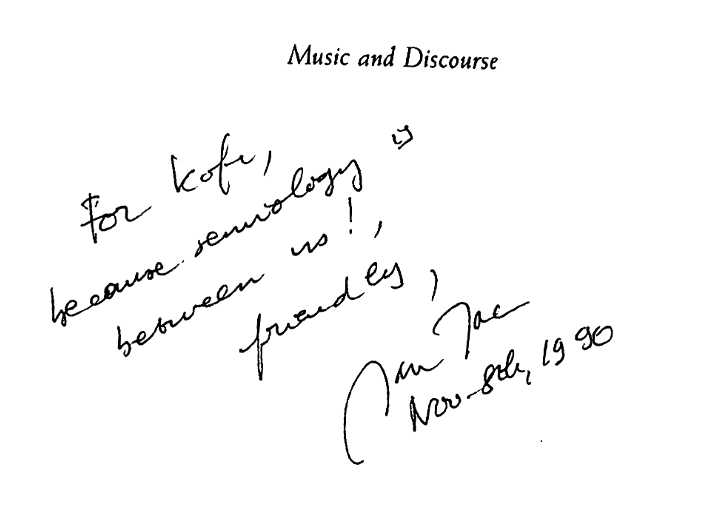
It was in your 1973 article “The Contribution of Musical Semiotics to the Semiotic Discussion in General” that I first encountered Roman Jakobson’s distinction between introversive and extroversive semiosis. This proved consequential for my own thinking as it allowed me to frame a time-honoured difference between two complementary aspects of a musical composition. But even before reading that article a decade or so after it appeared, I had been introduced to your early formulations in musical semiology by Arnold Whittall and Jonathan Dunsby. This way of thinking, at once concrete and malleable, brought much excitement to younger analysts in the 1980s and after. We poured over your 100-page analysis of Varèse’s Densité 21.5, marvelled at its unique balance between procedural rigour and conceptual comprehensiveness, and wondered if we could each go home and do likewise. To this day, I never teach a class on comparative analysis or semiotics without including that article. The climate of music theory in those days—1980s into the 1990s, at least in the Anglo-American world—privileged attention to structure over expression, but the tripartition allowed us to glimpse a path to having it both ways. We would soon be reminded (in your 1987 Music and Discourse, and please see the much-cherished exhibit below!) that your own vision of semiology continued to evolve, and that the strategic isolationism of Fondements (1975) was exactly that: strategic. Now (1987) Peircean semiotics, along with issues of meaning and discourse, not to mention your ongoing engagement with ethnomusicology, were increasingly central, and we sensed an expanding universe of interests and methodologies even as we learned to develop a new self-awareness as analysts. It was only logical, then, that you would go on to edit the Enciclopedia della musica—rich, provocative, and helpful as a reference. Thank you for inviting me to contribute to it and for telling me “not to panic” when, late in the process, you asked for an additional—short—essay for which you provided me with an outline based on a close reading of my Northern Ewe book. Your energy, intellectual intensity, warmth, and generosity as I have encountered them in your numerous writings, talks, and conference presentations remain vivid to me. If one thought that you were taking a much-deserved break after the publication of the Enciclopedia, one would be wrong because it would not be long before we would see your big book on the Shepherd’s melody from Act 3 of Wagner’s Tristan. You once told me that you were working on a project that would prove that the tripartition actually works, and that one half of it would focus on Wagner’s music while the other half focused on African music! While we wait for the latter, we can draw inspiration from your book-length study of 42 bars of Wagner’s music. You flesh out the domain of the poietic without sacrificing any of the insights that emerge from the other poles of the tripartition, and you do so in collaborative ways that are nowadays considered essential to the ethical practice of music analysis. No praise song can possibly acknowledge all the strands in your work, so please accept this as an acknowledgment that for me and those of our colleagues who came of age in the 1980s and 1990s, our thinking about analysis and semiology is scarcely imaginable without you. Thank you, Jean-Jacques, and a happy 80th!
 |
RMO_NATTIEZ_Agawu |
Attention : le logiciel Aperçu (preview) ne permet pas la lecture des fichiers sonores intégrés dans les fichiers pdf.
Citation
- Référence papier (pdf)
Kofi Agawu, « A Praise Song for Jean-Jacques Nattiez on his 80th Birthday », Revue musicale OICRM, numéro hors série, 2026, p. 26-27.
- Référence électronique
Kofi Agawu, « A Praise Song for Jean-Jacques Nattiez on his 80th Birthday », Revue musicale OICRM, numéro hors série, 2026, mis en ligne le 12 mars 2026, https://revuemusicaleoicrm.org/rmo-hors-serie/praise-song-nattiez/, consulté le…
Author
Kofi Agawu, The Graduate Center, CUNY
Kofi Agawu was born in Ghana, where he received his initial education before studying composition and analysis in the UK and musicology in the US. He is currently Distinguished Professor at The Graduate Center, CUNY. His books include Playing with Signs (1991), Music as Discourse (2008), and The African Imagination in Music (2016). Recent awards include the IMS Guido Adler Prize (2023) and a 2024 Wallace Berry Award from the Society for Music Theory for his most recent book, On African Music (2023). A Fellow of the Ghana Academy of Arts and Sciences, he is also Corresponding Fellow of the British Academy.